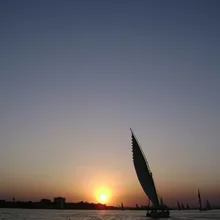
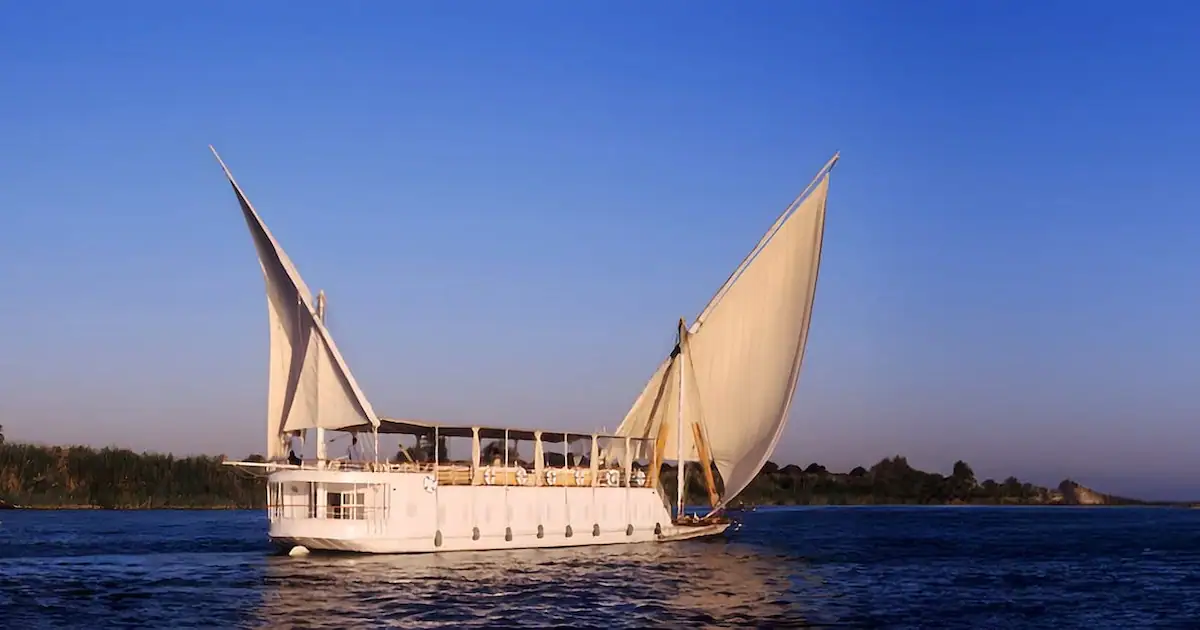
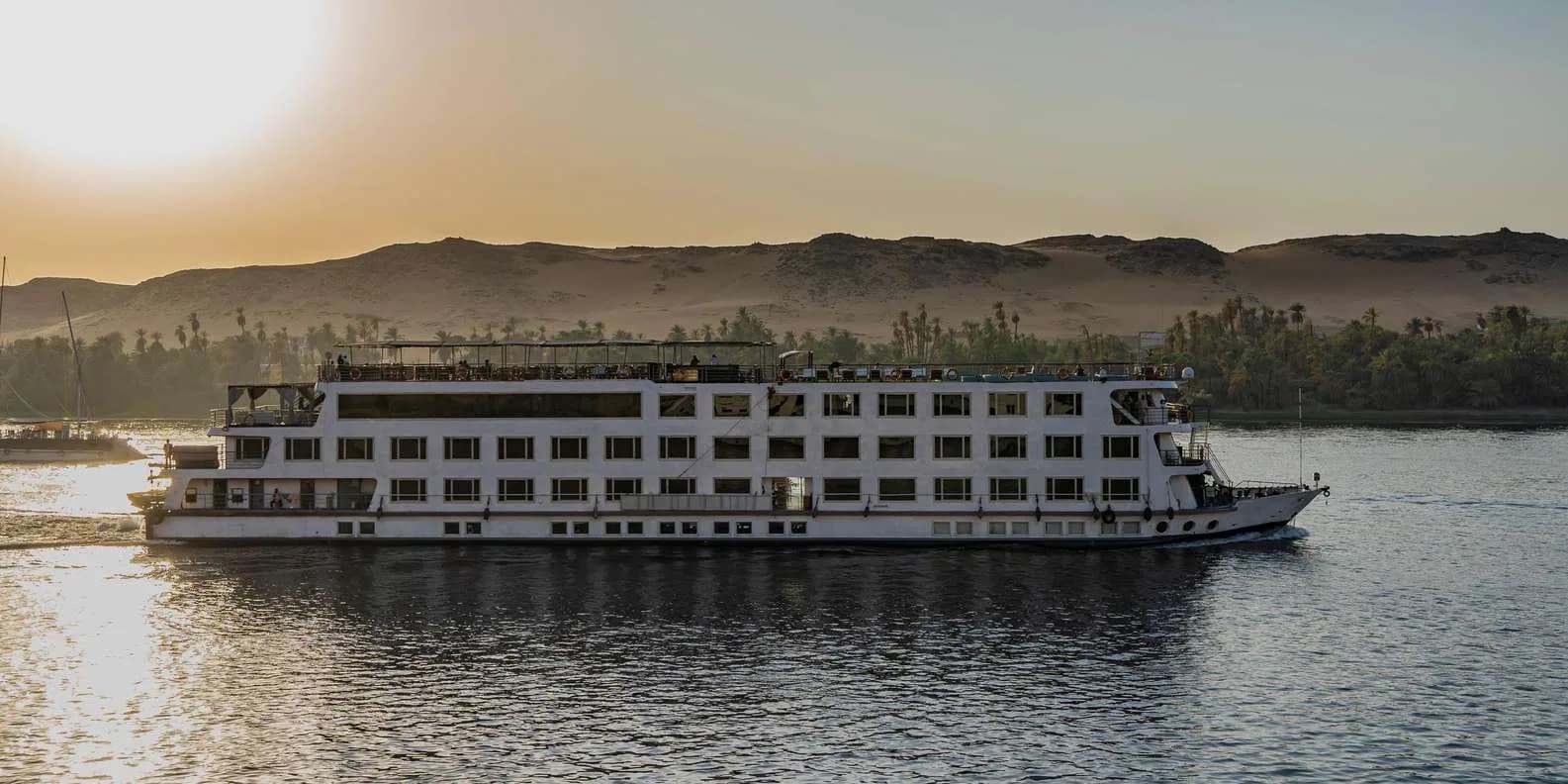
 Photo by Votpuske, via Wikimedia Commons, CC BY-SA 4.0
Dahabiya Nile Cruise: Egypt’s Small Sailing Boats (2026/2027)
The wind-powered alternative to Egypt’s 100-passenger cruise ships: what a dahabiya is, the real boats and fleets sailing in 2026, routes, seasons and costs.
Nile Cruises & Dahabiyas
Turn this guide into a trip
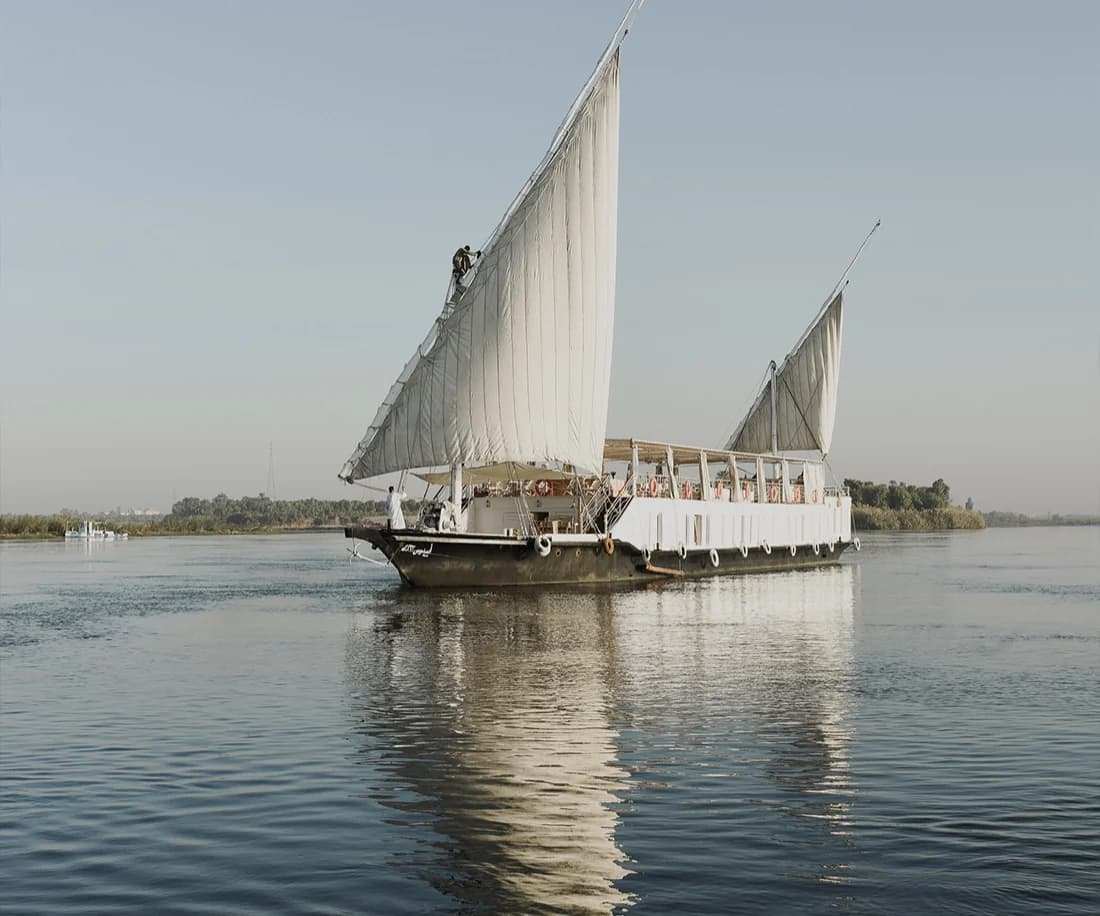
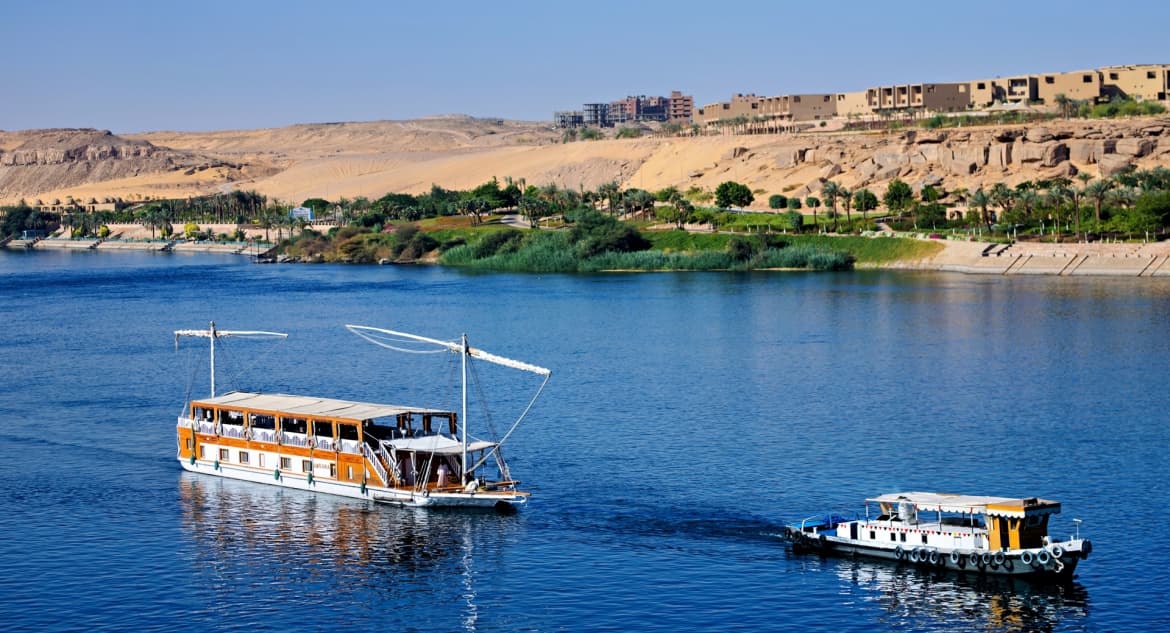
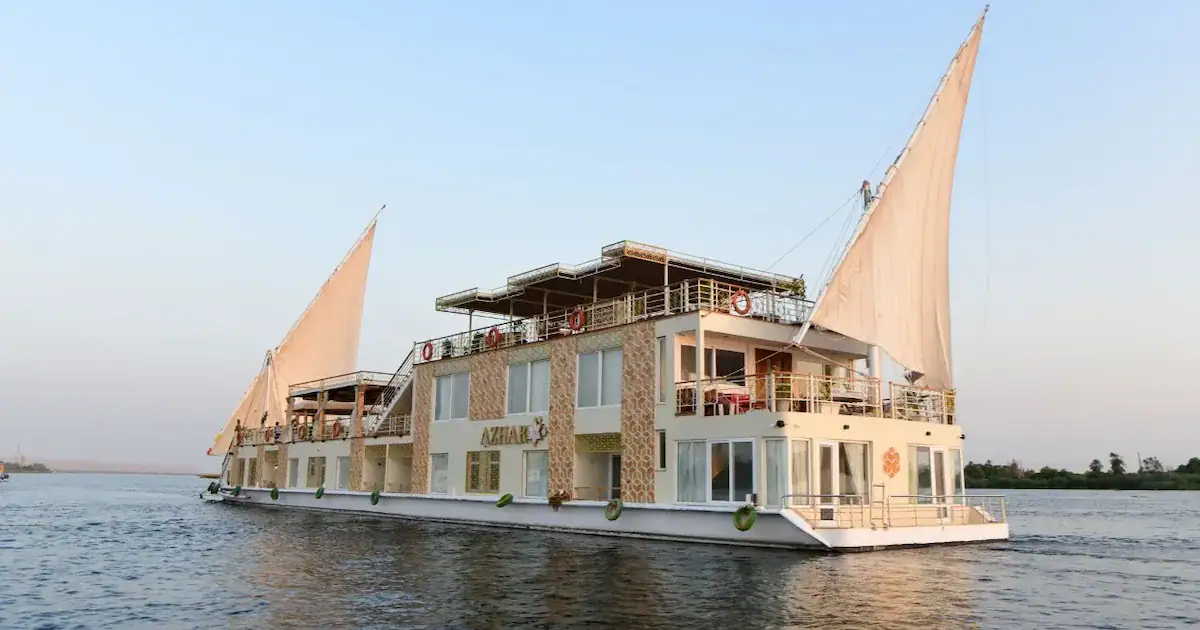
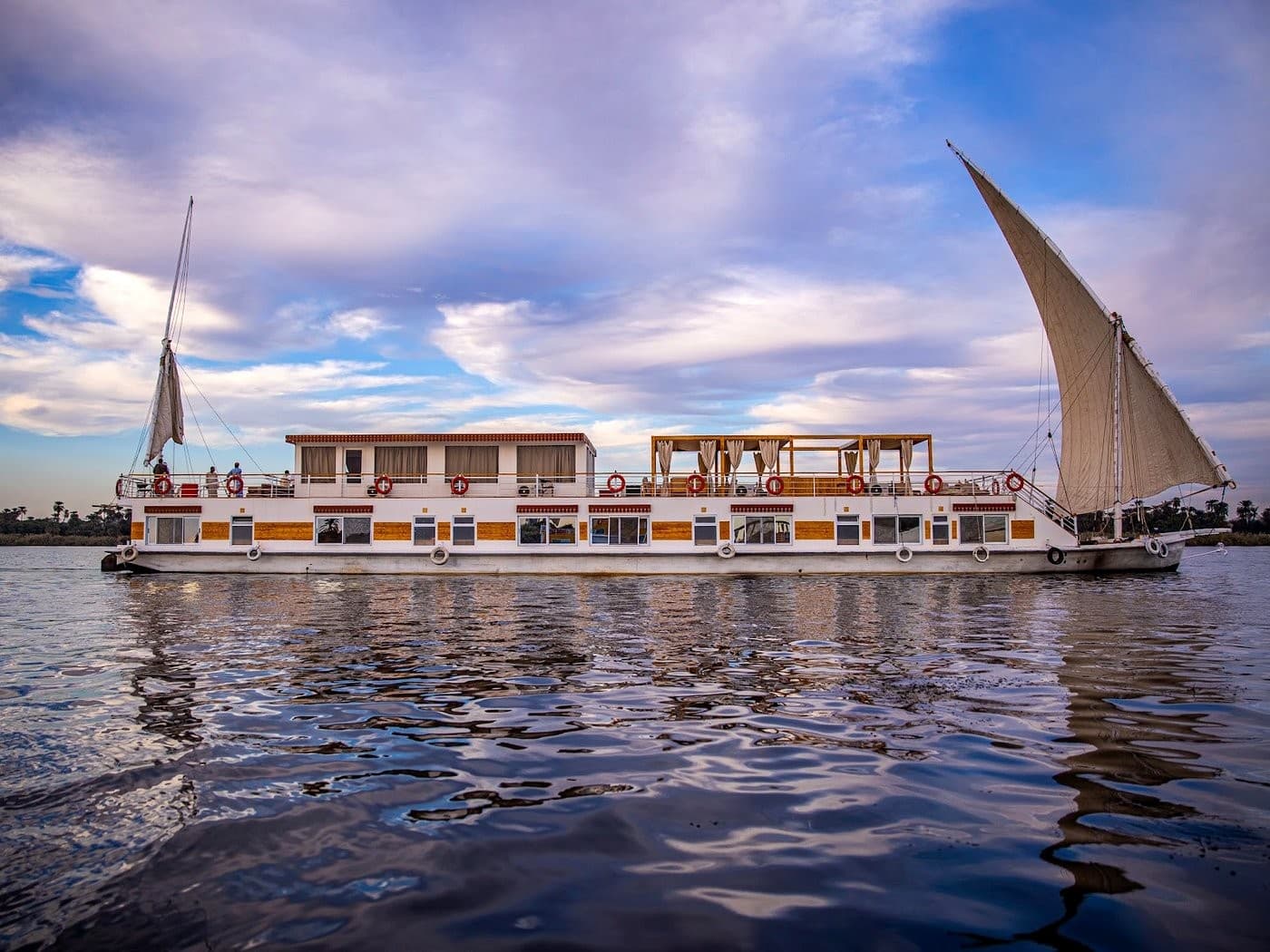
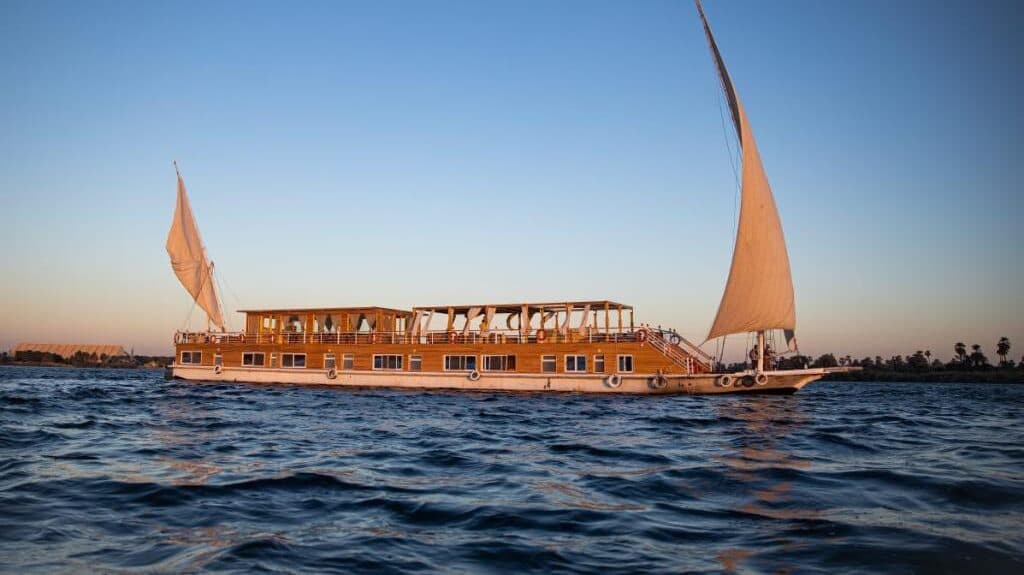
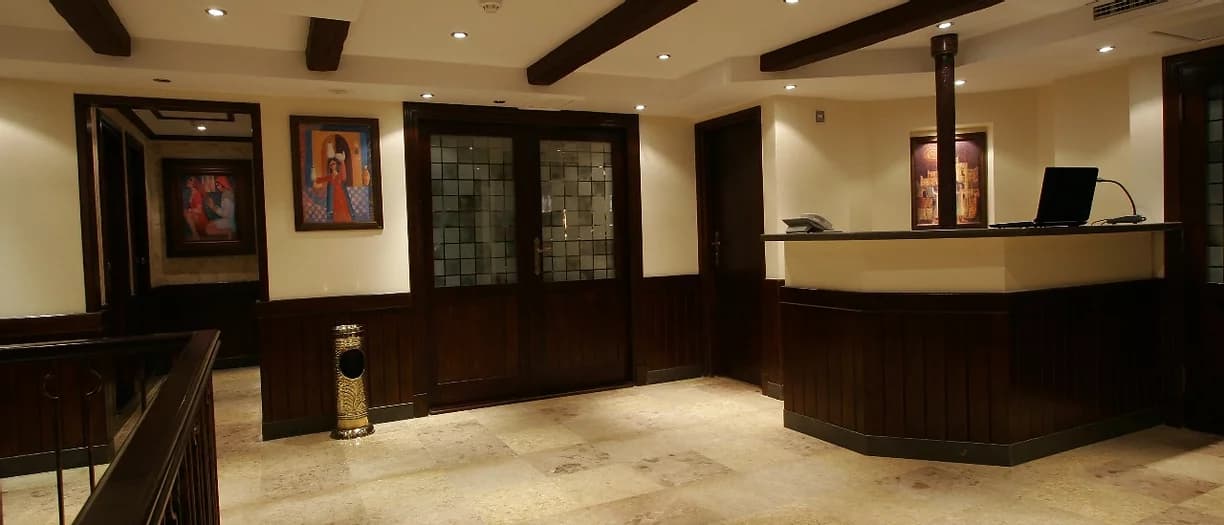
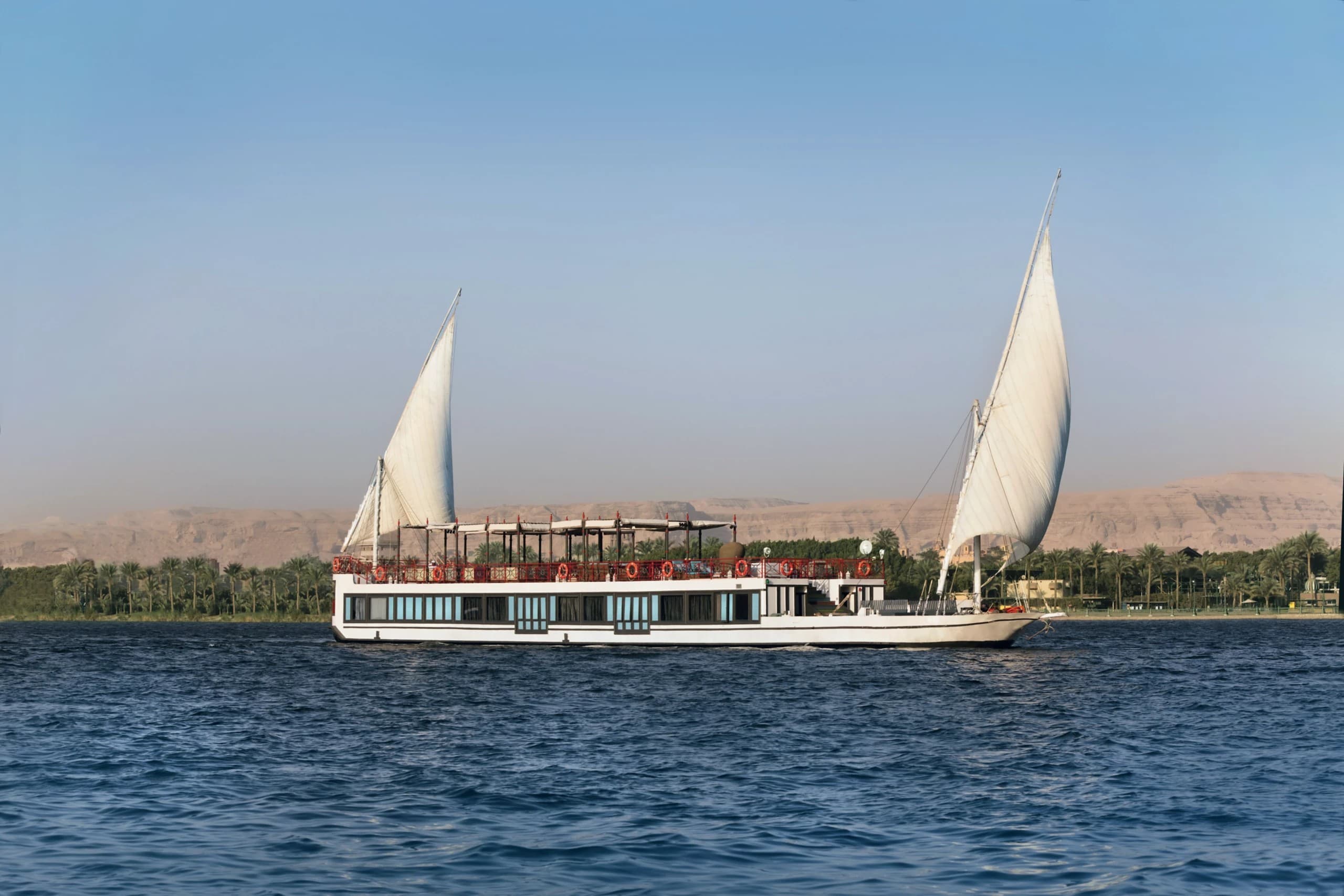
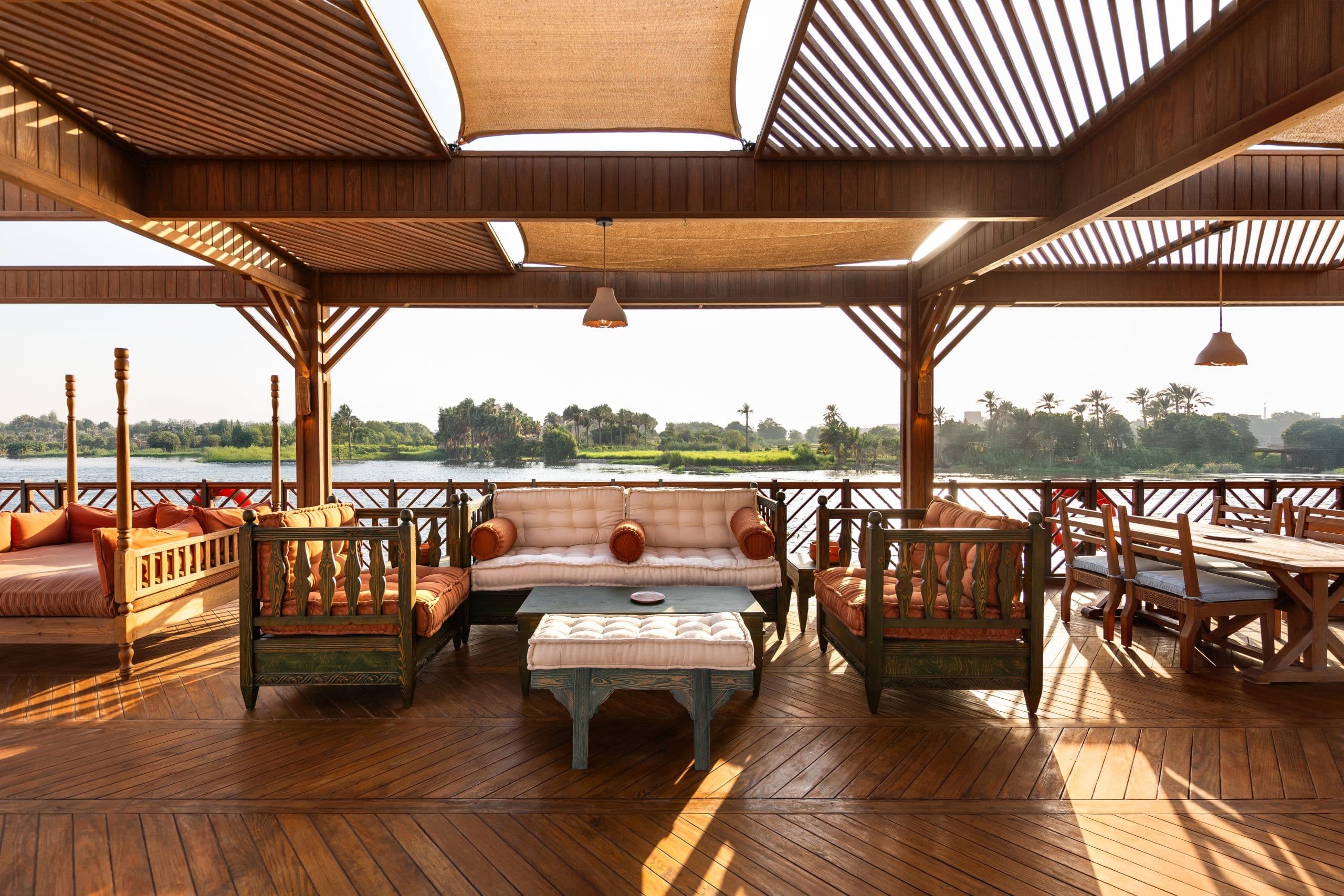
Quick answer: A dahabiya is a small, twin-sailed Nile boat — usually 4–12 cabins (8–24 guests) — the intimate, wind-powered alternative to the 100-plus-passenger cruise ships. It's the boat to pick for a luxury small-boat Nile cruise: quiet, private, and able to moor at sandbanks and villages the big ships sail past. Dahabiyas run Luxor–Aswan over 4–7 nights, and because each boat is tiny and demand is high, they book out months ahead. Browse all 104 in the dahabiya directory.
Dahabiya vs cruise ship
| Dahabiya (small sailing boat) | Five-star cruise ship | |
|---|---|---|
| Size | 4–12 cabins, 8–24 guests | 50–80 cabins, 100–160 guests |
| Pace & feel | Slow, wind-powered, private, intimate | Faster, full facilities, sociable |
| Moors at | Quiet sandbanks & small villages | Main docks in Edfu, Kom Ombo, etc. |
| Best for | Couples, families & groups wanting seclusion | Facilities, pool/spa, lower per-cabin cost |
| Trip | Luxor–Aswan, 4–7 nights | Luxor–Aswan, 3–7 nights |
| How to book | Enquire on the dahabiya directory or WhatsApp | Enquire on the cruise directory or WhatsApp |
A dahabiya is a small, twin-sailed Nile boat — usually four to twelve cabins, carrying eight to twenty-four guests — that moves the old-fashioned way, by wind, and is towed by a small tug only when the breeze dies. It is the quiet opposite of the 100-to-160-passenger cruise ships that fill the Luxor–Aswan run. Book one when you want the river the way Victorian travellers knew it: slow mornings under canvas, moorings on empty sandbanks, and a route that skips the crush of the big town docks.
The market is bigger than most people realise. Across the Esna–Aswan reach there are roughly 104 sailing dahabiyas run by about 17 named fleets — plus a long tail of nearly 50 boats sold only through agents, with no operator willing to put its name to them. This guide explains what a dahabiya actually is, names the real boats and fleets sailing in 2026, compares them to a standard floating hotel, and lays out routes, seasons and what it all costs in USD and EGP. For the full fleet of larger vessels, see our 2026 Nile cruise ships guide; for the top end, our luxury Nile cruises guide.
What exactly is a dahabiya?
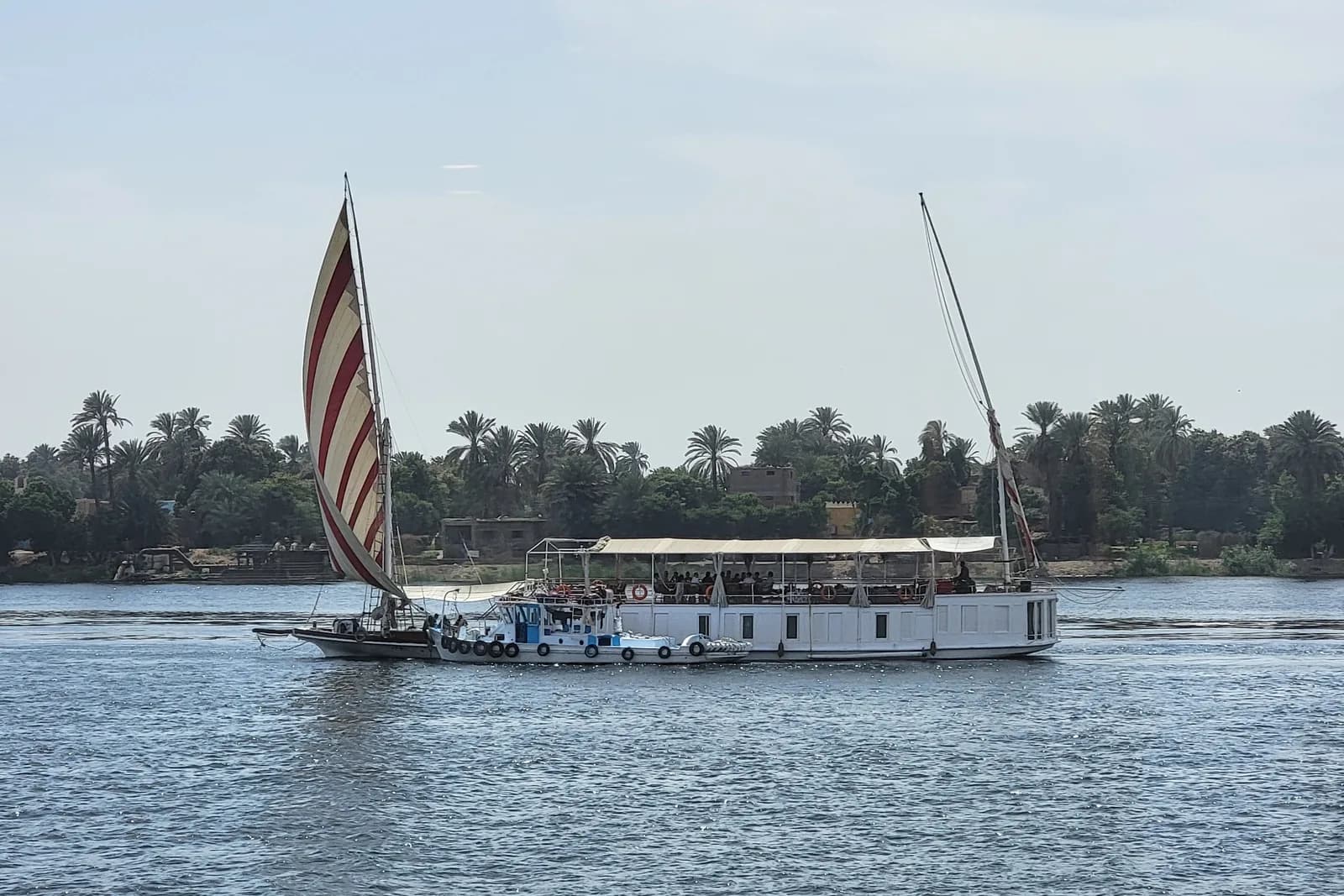
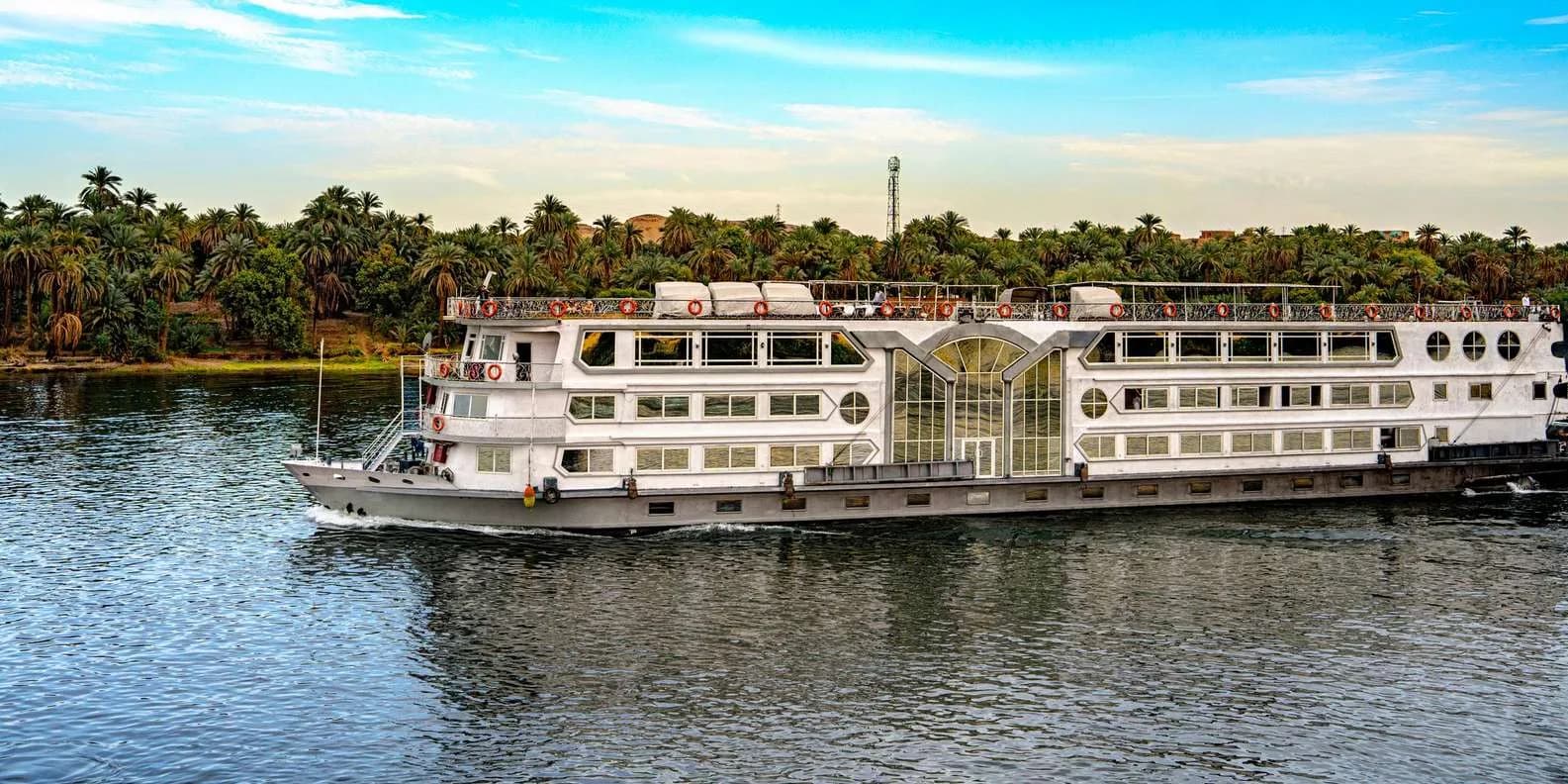
The word comes from the Arabic dhahab, meaning gold — a nod to the gilded ceremonial barges that once carried Egypt’s rulers along the river. A modern dahabiya keeps the shape: a long, low, flat-bottomed wooden hull that sits close to the water, with two lateen (triangular) sails, a large one forward and a smaller one aft. There is no towering superstructure, no disco, and often no engine at all. When the wind fails, a small tug takes the dahabiya under tow, then drops the line the moment the sails can fill again.
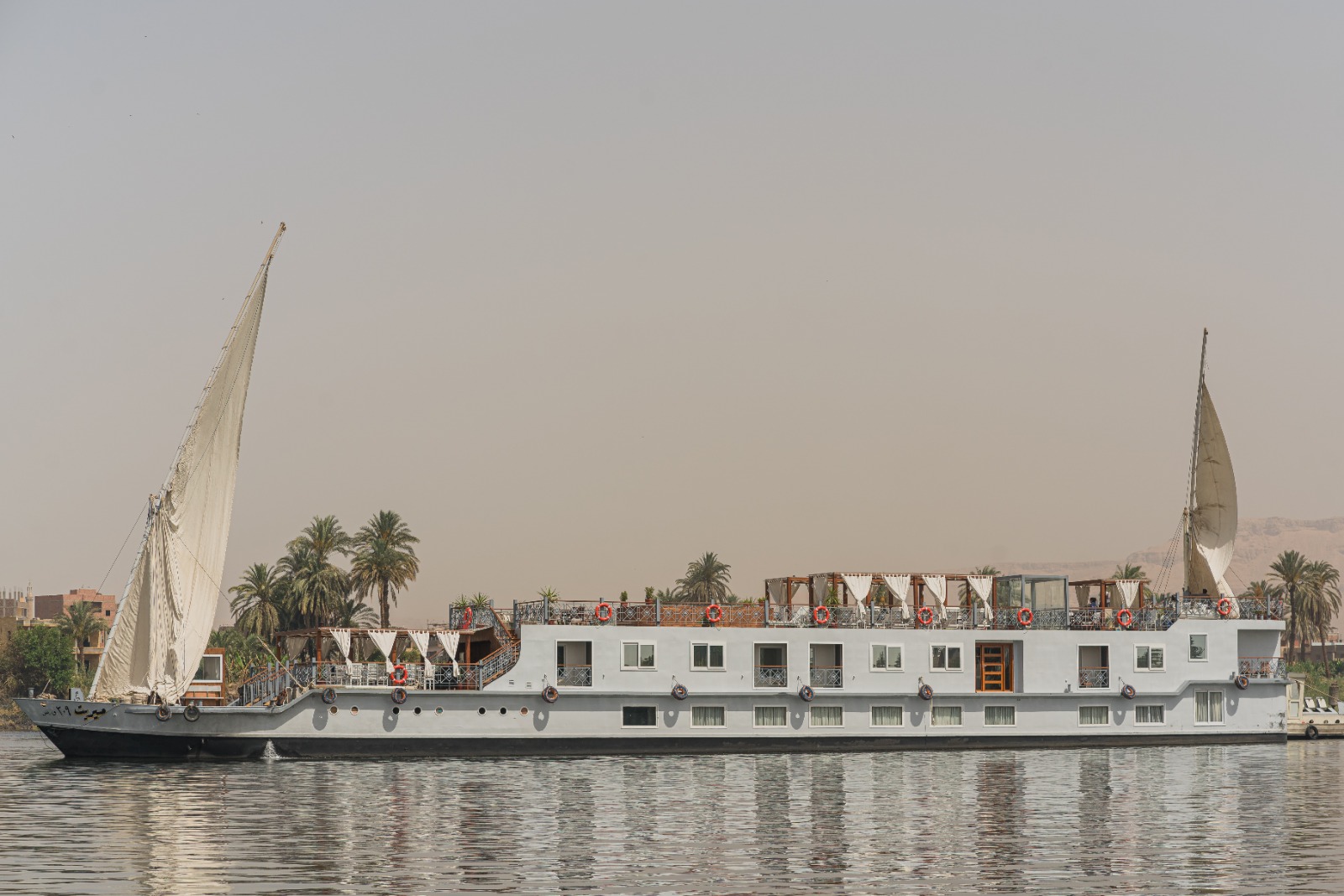
Scale is the whole point. Where a cruise ship packs 50 to 80 cabins over five decks, a classic dahabiya has just four to twelve, and the crew can nearly outnumber the guests. Many boats are chartered whole by a single family or group of friends. The result feels closer to a private sailing yacht with a cook and a guide than to a hotel that happens to float.
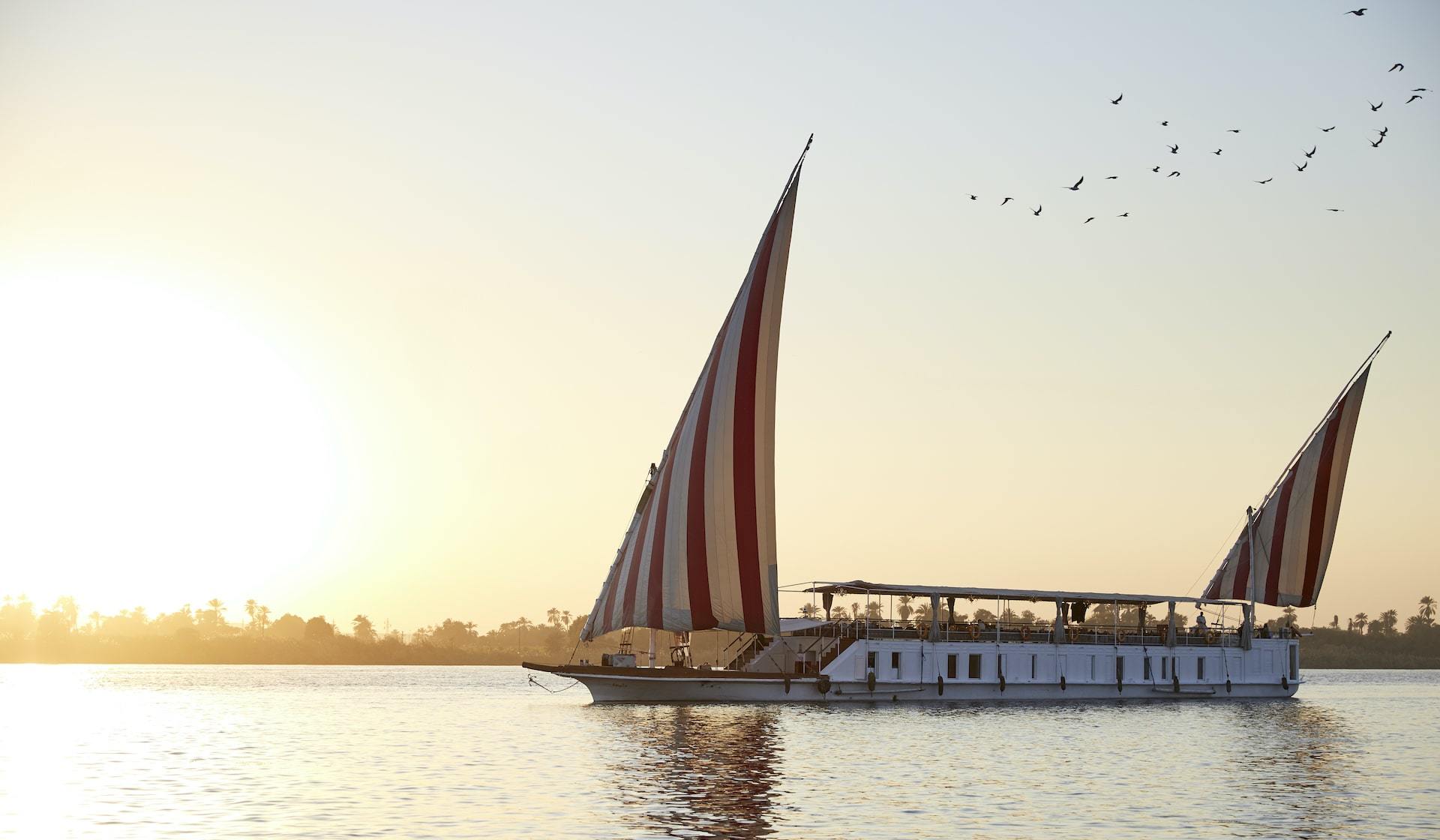
Don’t confuse a dahabiya with a felucca. A felucca is a single-sail open day boat with no cabins — perfect for a sunset hour on the water at Aswan, but not for sleeping. The dahabiya is its bigger, cabined cousin, built for multi-night journeys. If a short sail is all you’re after, read our felucca ride guide.
A short history: why dahabiyas came back
In the 19th century the dahabiya was the way wealthy Europeans saw Egypt. Travellers rented a boat and crew for weeks at a time and drifted upriver at the pace of the wind. Amelia Edwards sailed one for her 1877 classic «A Thousand Miles up the Nile», and the boats were fixtures of the Grand Tour long before package cruising existed. Then came the steamer, and later the diesel engine, and the sailing boats all but vanished — faster, bigger vessels could keep a schedule the wind never could.
The revival is recent. From the early 2000s a handful of operators rebuilt traditional dahabiyas from scratch, fitting en-suite cabins and shaded decks to hulls that still sail the way they always did. The French-run Nour El Nil led the way and now sails nine boats — Adelaïde, Agatha, Dendera, El Nil, Malouka, Meroe, Najafa, Poppee and Roman — not the six figure repeated across half the internet. A few boats trade on genuine age: Saray El Nil claims an 1882 hull, and Dahabiya Dream a 1920 one. Today these boats occupy the quiet, high-touch end of the Nile market: too few to crowd the river, deliberately slow, and priced for privacy rather than volume.
Dahabiya vs the big cruise ships
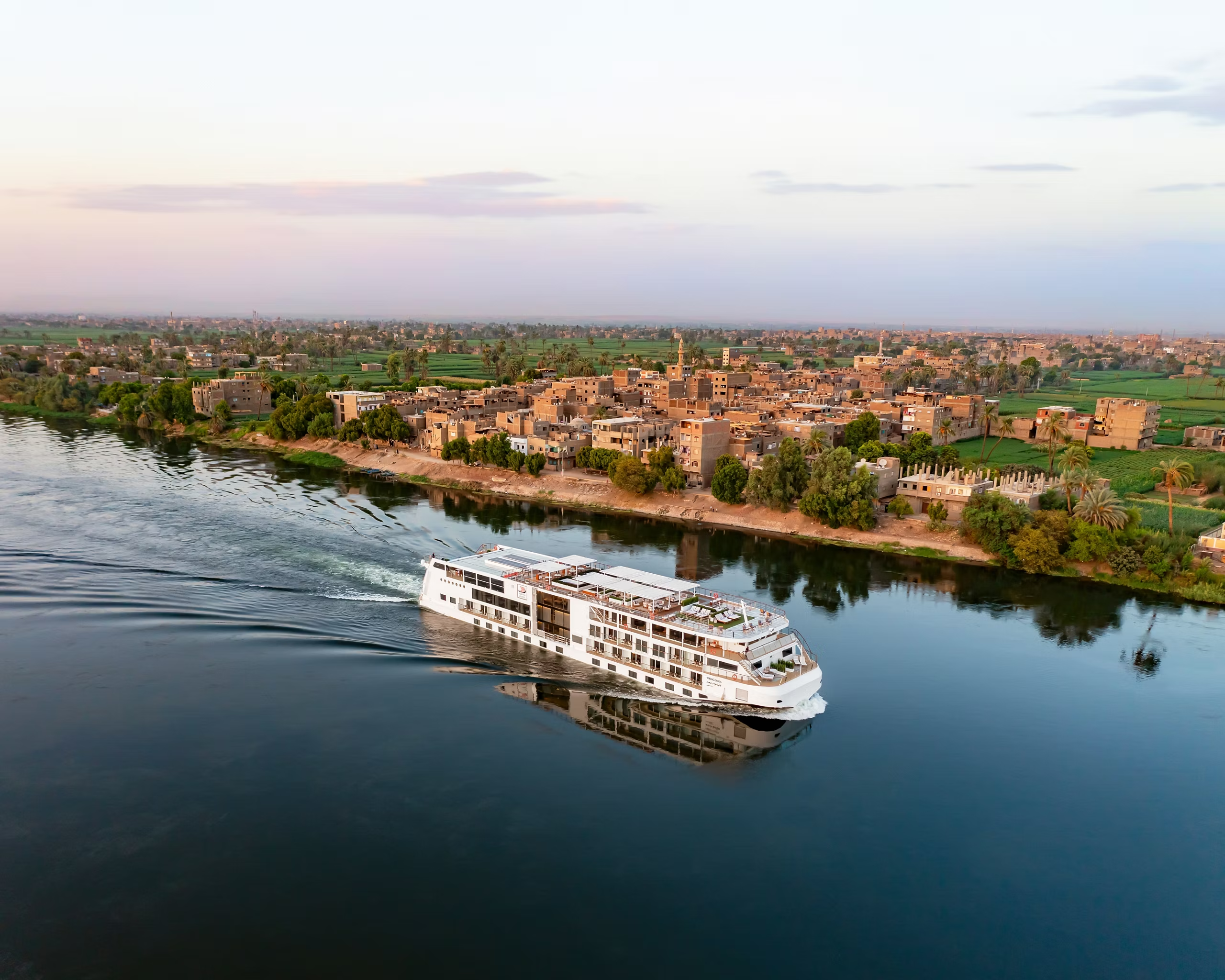
Both types visit the same monuments, but the experience could hardly be more different. A dahabiya trades the pool deck and the nightly floor show for silence, space, and a route the large boats can’t reach.
| Feature | Dahabiya (sailing) | Standard cruise ship |
|---|---|---|
| Guests | 8–24 | 100–160 |
| Cabins | 4–12 | 50–80 |
| Power | Twin lateen sails, towed when calm | Diesel engines |
| Pace | Slow, wind-led, near-silent | Fixed engine timetable |
| Where it moors | Sandbanks, islands, small villages | Big town docks, rafted 4–6 boats deep |
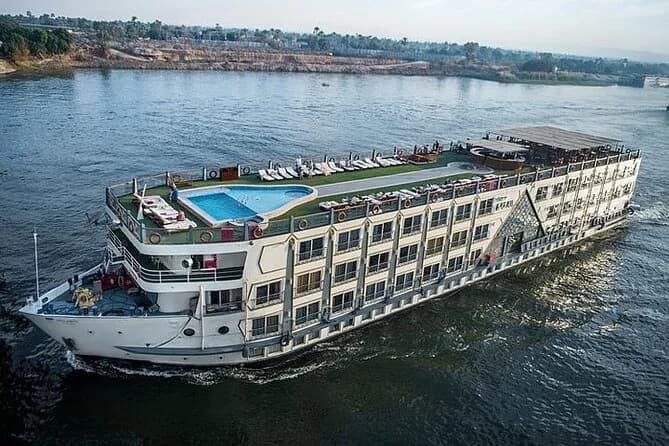
| On board | Sun deck, shaded lounge, home cooking | Pool, bars, disco, nightly shows |
| Typical route | Esna ↔ Aswan | Luxor ↔ Aswan |
| Best for | Privacy, couples, whole-boat charters | Value, facilities, first-timers |
| From, 3–4 nights pp | ~US$300–1,600 (much higher for the luxury sail boats) | ~US$100–700 |
That last row deserves a caveat: the cheapest big-ship fares undercut almost any dahabiya, because you’re sharing fixed costs with a hundred other passengers. On a small boat you’re paying for scarcity — fewer cabins, more crew per guest, and quiet water. At the very top, a handful of ultra-private sail boats such as Ashranda’s Eyaru run into five figures per person.
The route: Esna to Aswan, and why it feels emptier
Dahabiyas concentrate on the southern half of the classic corridor, sailing between Esna and Aswan rather than starting at Luxor. There’s a practical reason. Boats travelling upstream (south) ride the prevailing north wind, so the sails do real work; the stretch above Esna is also calmer and dotted with small moorings the big ships steam straight past.
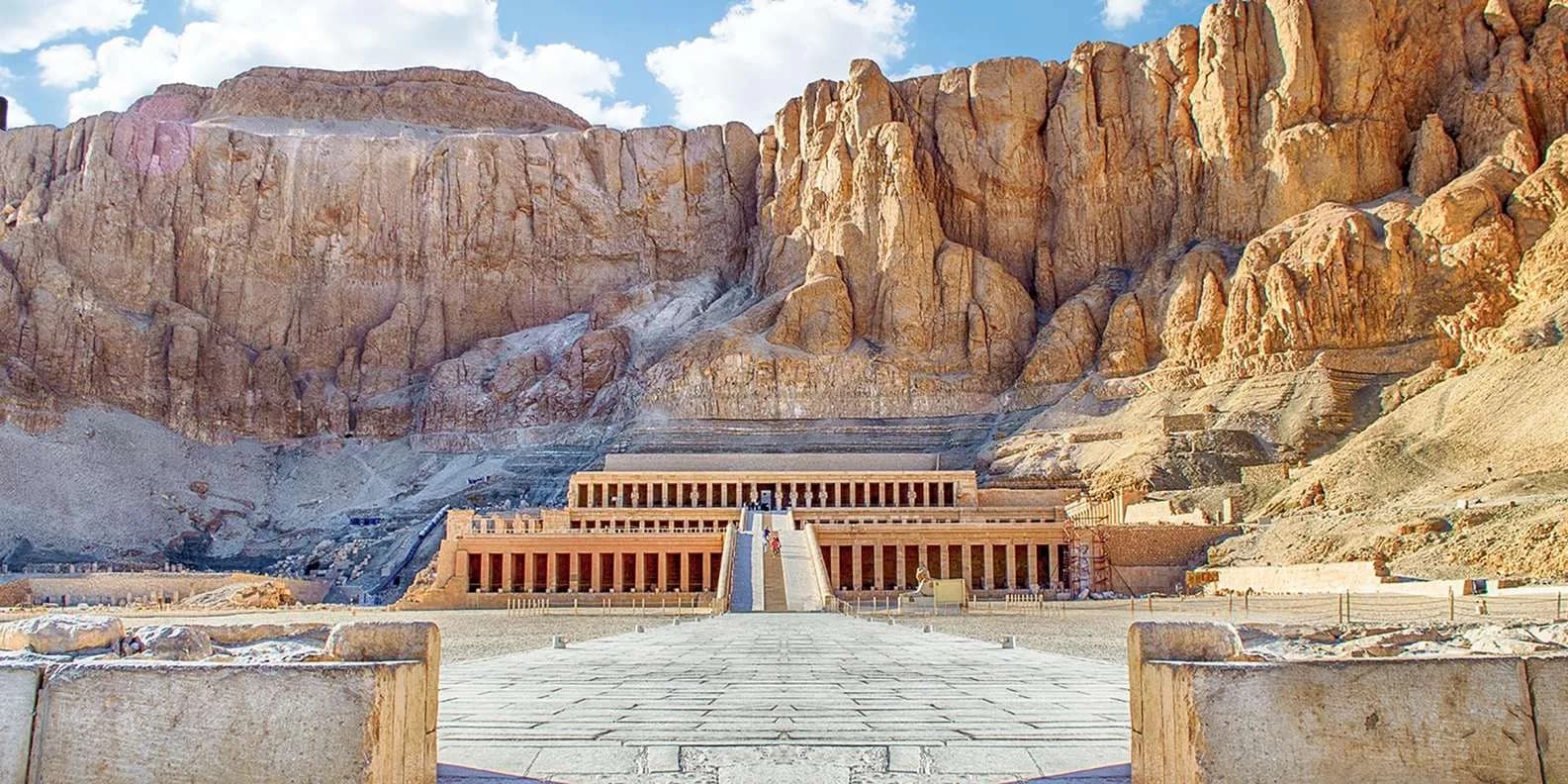
The itineraries repeat with small variations: Esna and its Temple of Khnum, El Kab’s rock-cut tombs, Edfu’s great Temple of Horus, the sandstone quarries of Gebel el-Silsila, then Kom Ombo right at the water’s edge, and finally Aswan with Philae and the High Dam. In between come the stops the floating hotels skip entirely — a Nubian village for lunch, Bassaw or El Ramady island, a beach where the crew rigs a table on the sand. You still see the headline temples, but often at odd hours, before or after the coach crowds arrive. The one shared bottleneck is the Esna lock, where every boat waits its turn to be lowered through.
Big ships, by contrast, run Luxor↔Aswan and tie up at the main town quays, frequently rafted four to six abreast so you cross other boats’ lobbies to reach the shore. For a fuller primer on the whole corridor — sites, timings and how the standard cruise works — see our Nile river cruise guide.
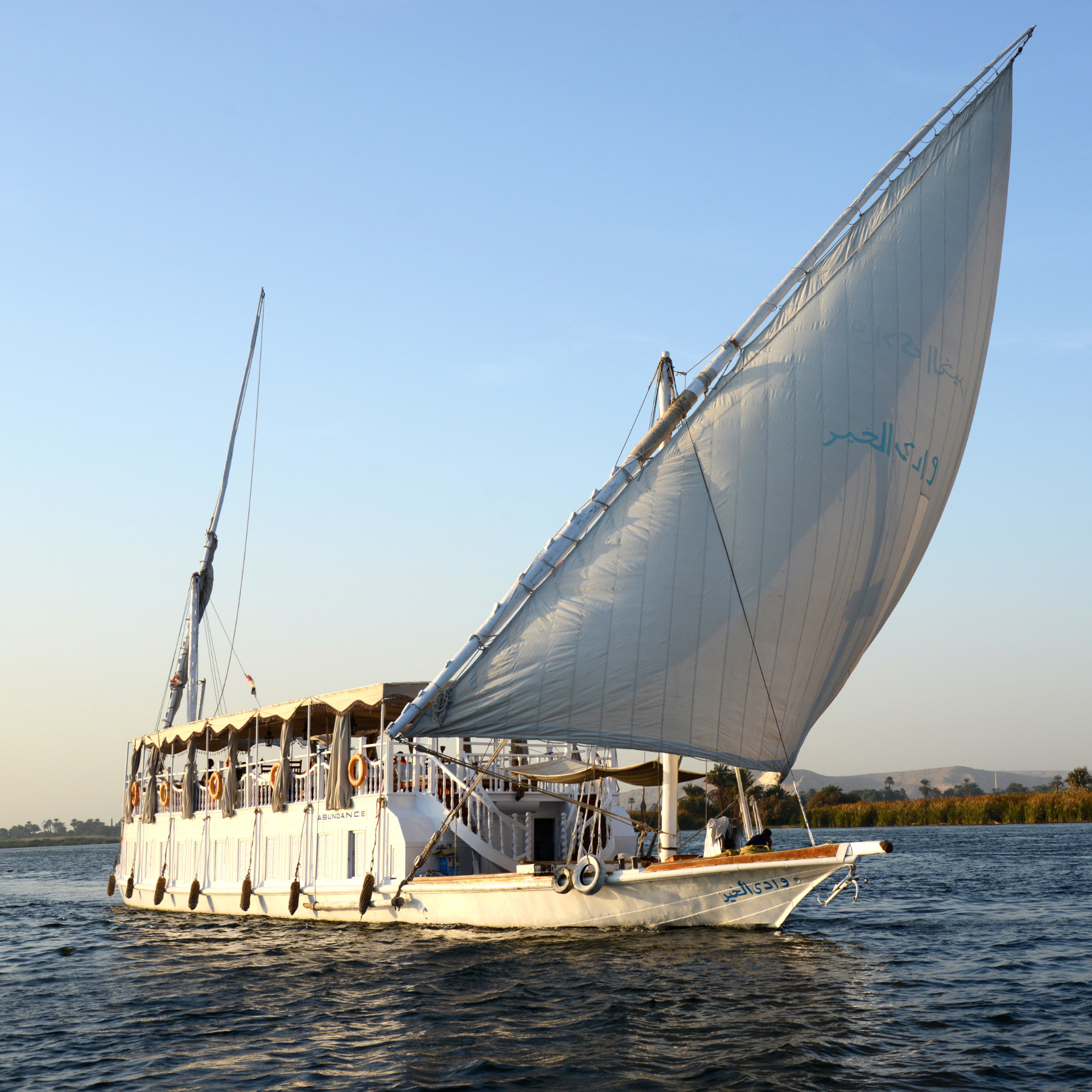
Every dahabiya sailing the Nile in 2026/2027, by fleet
There are 108 dahabiyas carrying guests on the Nile, run by 24 named operators plus a long tail sold without one. That count is the whole point of this section: most guides name eight or ten boats, which is the handful their partners sell. Below is the full picture.
| Fleet | Boats | Cabins | Per person per night | Typical route |
|---|---|---|---|---|
| Oriental Nile Cruises | 12 | 5 to 14 | ~US$93 to 840 | Luxor to Aswan, 5 nights |
| Nour El Nil | 9 | 10 | ~US$577 to 1,577 | Luxor to Aswan, 5 nights |
| Lazuli | 7 | 5 to 10 | ~US$370 to 375 | both directions, 3/4/5 nights |
| Ashranda | 6 | 7 to 10 | ~US$386 to 1,656 | both directions, 3/4 nights |
| Merit Dahabiyas | 4 | 8 to 12 | ~US$333 to 500 | both directions, 3/4/5 nights |
| A small private fleet (The Orient, Loulia, Nora, Zekrayaat) | 4 | 5 to 6 | ~US$378 to 380 | both directions, 3/4 nights |
| Jaz Cruises | 3 | 6 | ~US$270 to 300 | Luxor to Aswan, 5 nights |
| Dahabiya Nile Sailing | 2 | 10 | ~US$257 | both directions, 3/4 nights |
| Extension Group | 2 | 10 | ~US$226 to 401 | not published |
| Mazaj Cruises | 2 | 5 to 9 | ~US$825 | Luxor to Aswan, 4/5 nights |
| Sonesta Cruise Collection | 2 | 7 to 9 | ~US$446 | Luxor to Aswan, 4 nights |
| Dahabiya Dream Luxury Nile Cruise | 1 | 6 | on request | not published |
| Hathor Cruise | 1 | 8 | ~US$767 | both directions, 3/4 nights |
| Kazazian Cruises | 1 | 9 | on request | Luxor to Aswan, 5 nights |
| Lumière Private Nile Cruise | 1 | 8 | on request | both directions, 3/4/5 nights |
| Mövenpick Hotels & Resorts | 1 | 4 | ~US$1,490 | Luxor to Aswan, 4 nights |
| Pyramids Dahabiya | 1 | 8 | ~US$533 | both directions, 3/4 nights |
| Route d'Egypte | 1 | 8 | ~US$367 | both directions, 3/4 nights |
| Sail the Nile | 1 | 5 | ~US$444 | both directions, 3/4 nights |
| Swan Dahabiya | 1 | 12 | ~US$300 | both directions, 3/4 nights |
| The AND Group Nile Cruises | 1 | 8 | ~US$462 | both directions, 3/4 nights |
| Turquoise Dahabiya | 1 | 8 | ~US$290 | both directions, 3/4 nights |
| No operator published | 44 | varies | ~US$111 to 1,180 | mixed |
Read the price column carefully, because it is the one number most sites get wrong. Operators quote on at least six different bases, some per person per night, some for a whole three or seven night sailing, a few per cabin. Put those side by side untouched and a boat quoting US$370 a night looks thirty times cheaper than one quoting US$11,590 for a week, when the real gap is about four times. Every figure above is normalised to per person, per night.
Nour El Nil is the name most travellers arrive with, nine boats on the Esna to Aswan reach, and it sits at the upper end. Oriental Nile Cruises runs the largest fleet at twelve boats and the widest price spread. Lazuli is the value pick, seven boats at a remarkably flat rate. Ashranda covers the luxury end, and Merit Dahabiyas the modern middle.
One caution before you book. 21 of the 108 boats name no operator at all, and 44 are sold only through agencies that will not say which company actually sails the boat. That is not always a problem, plenty are good boats, but you are buying from a reseller and the crew, maintenance and cancellation terms are whoever they turn out to be. Ask who operates the hull before you pay a deposit.
Ten boats, compared properly
These are the boats most often asked about, with the two columns other listings get wrong kept apart. Hull length is not a build year, and the rate is normalised per night.
| Boat | Fleet | Cabins | Built | Length | Per person per night |
|---|---|---|---|---|---|
| Adelaïde | Nour El Nil | 10 | 2019 | 55.0 m | ~US$577 |
| Eyaru | Ashranda | 8 | — | 50.0 m | ~US$1,656 (rates conflict across agencies) |
| Nebyt | Ashranda | 7 | 2011 | 43.0 m | ~US$891 |
| Loulia | Small private fleet | 6 | — | 38.5 m | ~US$380 |
| Merit Star | Merit Dahabiyas | 12 | — | 55.0 m | ~US$500 |
| Abundance | Sail the Nile | 5 | — | 35.0 m | ~US$444 |
| Lazuli Abydos | Lazuli | 10 | 2022 | 45.0 m | ~US$370 |
| Three Pyramids | Pyramids Dahabiya | 8 | 2019 | 40.0 m | ~US$533 |
| Swan | Swan Dahabiya | 12 | — | — | ~US$300 |
| Sonesta Amirat Dahabeya | Sonesta Cruise Collection | 7 | 2009 | — | ~US$446 |
The Ashranda boats are the closest thing to a private super-yacht on the river: five-star, single-digit cabin counts, and headline fares to match. Eyaru and Nebyt run into the thousands per person; Nofret and Nonia keep the same feel. At the other end, Lazuli’s Abydos and Karnak, or Merit’s modern hulls, bring the sailing experience within reach of a mid-range budget. And if old-world romance is the draw, Saray El Nil’s 1882 hull and Dahabiya Dream’s 1920 one carry more history in their timbers than any new build.
A note on the word ‘dahabiya’ in booking listings: because the term sells, some operators apply it loosely to any small, well-appointed boat, sail or no sail. If genuine sailing matters to you, ask the direct question — does the boat actually raise sails, and does it carry an engine? A real dahabiya answers yes to the first and, often, no to the second.
What a dahabiya cruise costs
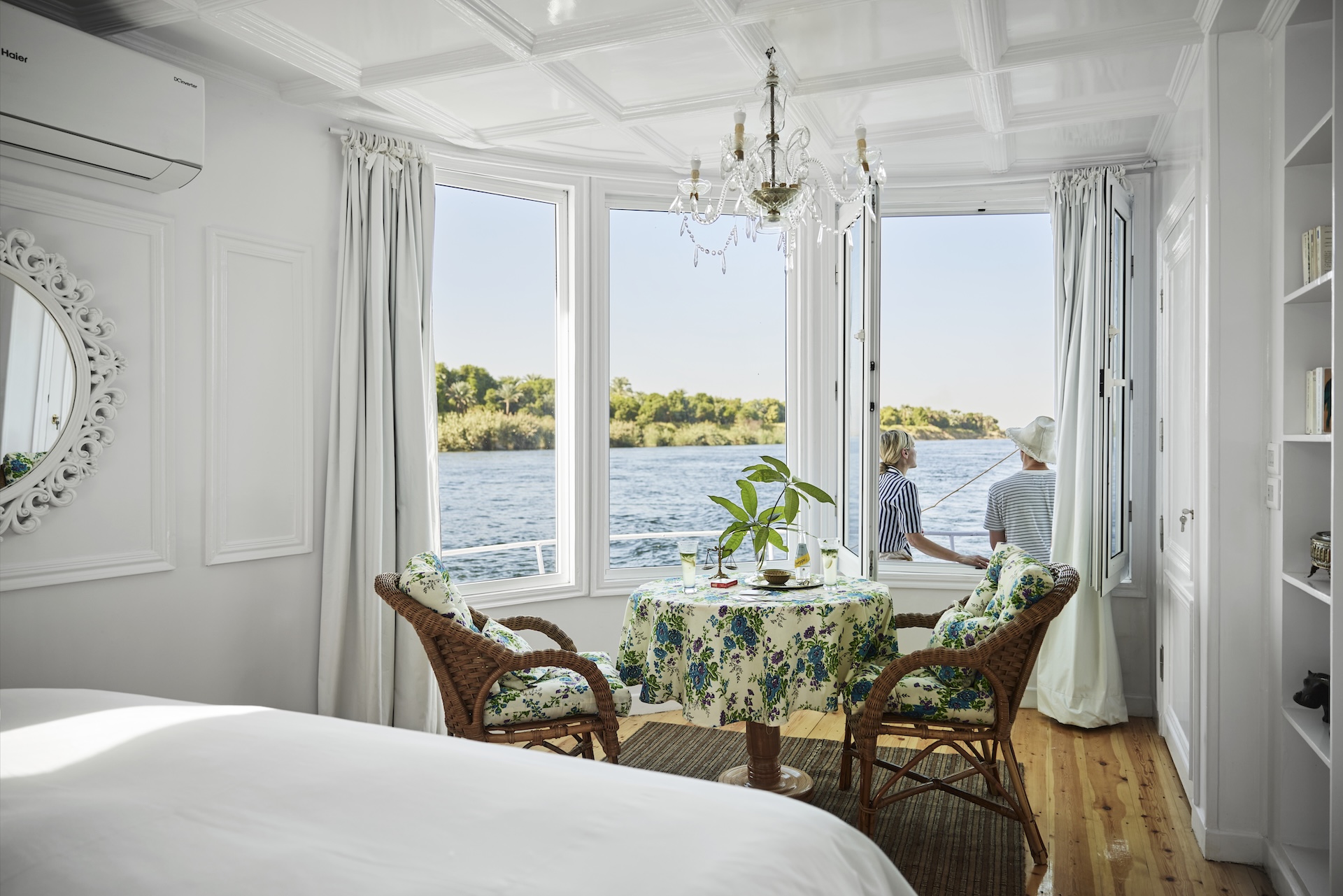
Pricing spans a huge range. The most accessible sailing boats — Lazuli Abydos, Rois, some Merit and Oriental itineraries — start around US$300–400 per person for a 3-to-4-night sailing, roughly EGP 15,000–20,000 at about 48–49 EGP to the dollar. Mid-market boats such as Loulia, Turquoise, Three Pyramids or Swan sit around US$700–1,600 (EGP 34,000–78,000). The luxury sail boats climb steeply: Ashranda’s Eyaru and Nebyt run US$2,700–18,700 per person, and the private-charter Mazaj SIA is quoted at US$20,000. As a category, Cruises & Sailing on our platform runs around EGP 13,900 median.
Genuine sail dahabiyas are often quoted per cabin or as a whole-boat charter rather than a headline per-person fare — many operators, Nour El Nil among them, publish rates only on request. Almost all fares are full-board. Check what’s excluded — temple entry tickets, drinks, the Egyptologist guide’s fee and staff tips are the usual extras — and confirm the current rate on the day, because Nile pricing moves with the season and the exchange rate.
When to sail
October to April is the sweet spot: warm days, cool evenings, and a reliable north wind for the sails. November to February is peak, with the most comfortable temperatures and the busiest temples. Summer (June–August) is punishing in Upper Egypt — 40°C and up — and while fares drop, a shadeless sun deck at midday is hard work. Ramadan and the days around it can shift the onboard rhythm, so ask before you book if that matters to you.
A day on board
Mornings start with tea on the open deck as the crew raises the sails. You drift for a few hours, the only sound the water and the rigging, then moor for a temple visit — often reached on foot, by donkey, or a short walk up a bank the coaches can’t get to. Afternoons are for reading, a swim off the boat where it’s safe, or simply watching the fields and palm groves slide by. Dinner is home-cooked Egyptian food, sometimes served on a sandbank around a fire, and because there’s no engine thrumming through the night, you fall asleep to silence.
Is a dahabiya right for you?
Choose a dahabiya if you value privacy, quiet and a slower pace; if you’re travelling as a couple or a group that can fill, or nearly fill, a boat; and if empty moorings appeal more than a pool deck. Look at a standard cruise ship instead if you want the lowest fare, a swimming pool and bar, evening entertainment, and a packed, guide-led schedule — or if you’re a first-timer who’d rather have every hour organised. Plenty of travellers do both: a big-ship segment for the headline sites, a dahabiya for the calm.
Ready to find your boat?
Browse dahabiyas, boutique small ships and full-size Nile cruises — with routes, cabin counts and live prices — on This is Egypt, and compare the intimate sailings against the larger fleet before you commit. If you’re still weighing options, our Nile cruise ships guide and luxury Nile cruises guide lay out the rest of the river side by side.
What guests say
Independent traveller reviews of boats in our directory, quoted with attribution via Tripadvisor and Cruise Critic:
- ★★★★★ “Everything was impeccable from start to finish—a truly unforgettable luxury experience.” — Rían O, on Anoush · via Tripadvisor
- ★★★★★ “The crew took exceptionally good care of us. The cabins were cozy and well cared for.” — Phoebus, on Princess Farida · via Tripadvisor
- ★★★★★ “My cruise on the beautiful Roman was beyond my dream—five nights and six days of bliss.” — Tanya H (Australia), on Roman · via Tripadvisor
- ★★★★★ “A dream, travelling the Nile on a traditional boat—I really enjoyed sailing Miran.” — Ashraf E (Cairo, Egypt), on Miran · via Tripadvisor
A real team available 24/7 to assist you — free
Seif and the team reply on WhatsApp 24/7 — trip questions, custom plans and booking help.
Ask Seif on WhatsAppCommon questions
What is a dahabiya?
A dahabiya is a small, traditional twin-sail Nile boat with roughly 4–12 cabins carrying 8–24 guests. It sails by wind and is towed by a tug only when the breeze drops, giving a slower, quieter, more private trip than a large cruise ship.
How many dahabiyas are there on the Nile?
Around 104 sailing dahabiyas operate on the Esna–Aswan reach, run by about 17 named fleets. Nearly half the boats, though, are sold only through agents with no published operator, so stick to named fleets like Nour El Nil, Oriental Nile Cruises, Ashranda, Lazuli or Merit if you want to know who is actually sailing your boat.
How is a dahabiya different from a Nile cruise ship?
Size and pace. A cruise ship carries 100–160 passengers in 50–80 cabins with a pool, bars and nightly shows; a dahabiya carries a couple of dozen guests, sails almost silently, and moors at small sandbanks and villages the big boats skip.
Which are the best-known dahabiya operators?
Nour El Nil (nine boats, rate on request) is the most famous. Oriental Nile Cruises runs one of the largest fleets; Ashranda (Eyaru, Nebyt, Nofret, Nuun) sits at the luxury end; Lazuli and Merit Dahabiyas offer more accessible modern boats. Sonesta, Mövenpick, Sail the Nile and Dahabeya Egypte run smaller fleets.
What route do dahabiyas sail?
Most sail the southern stretch between Esna and Aswan rather than starting at Luxor, calling at Esna, El Kab, Edfu, Gebel el-Silsila, Kom Ombo and Nubian villages. The prevailing north wind favours the upstream, southbound leg, which is why the boats run this direction under sail.
How much does a dahabiya cruise cost?
The most accessible sailing boats start around US$300–400 per person for 3–4 nights (about EGP 15,000–20,000). Mid-market boats run US$700–1,600, and luxury sail boats like Ashranda’s Eyaru climb to US$2,700–18,700. Fares are usually full-board; tickets, drinks and tips are extra, and many operators quote per cabin or on request.
Is a dahabiya the same as a felucca?
No. A felucca is a single-sail open day boat with no cabins, used for short sails around Aswan. A dahabiya is larger, has twin sails and en-suite cabins, and is built for multi-night journeys.
When is the best time for a dahabiya cruise?
October to April, for warm days, cool nights and dependable wind. November to February is peak and the most comfortable; summer is very hot in Upper Egypt, often 40°C and above, though fares are lower.
Can you charter a whole dahabiya?
Yes. Because they hold so few guests, dahabiyas are frequently booked as private whole-boat charters for families or groups of friends, with a flexible itinerary you help plan. It is one of the main reasons people choose a dahabiya over a shared cruise ship.
How big is a dahabiya compared with a cruise ship?
A dahabiya is tiny by comparison: 4–17 cabins (about 8 on average, so roughly 8–24 guests), versus 6–80 cabins on a Nile cruise ship (typically around 50, carrying 100–160 guests). This is Egypt's directory lists 105 dahabiyas from operators such as Nour El Nil, Lazuli and Dahabeya Egypte.
Book it on This is Egypt
Turn this guide into a trip




Egypt's bestsellers
The experiences travelers book most, across the country






Plan your Nile cruise
Dahabiyas featured in this guide
Free downloads
Take the Nile home with you
Two illustrated PDFs, no email required: our 12-page introduction to choosing between a cruise ship and a dahabiya, and the classic 4-night Luxor to Aswan itinerary, day by day.
Keep reading
Nile Cruise from Aswan to Luxor (or Luxor to Aswan): 2026 Guide
A 3 or 4 night cruise between Aswan and Luxor is the classic way to see Egypt's temples. The stops, real prices, why direction and boat choice matter, and how to avoid a bad one.
By TiE Editors9 min read
Jaz Nile Cruises (2026): Fleet, Routes & How to Book
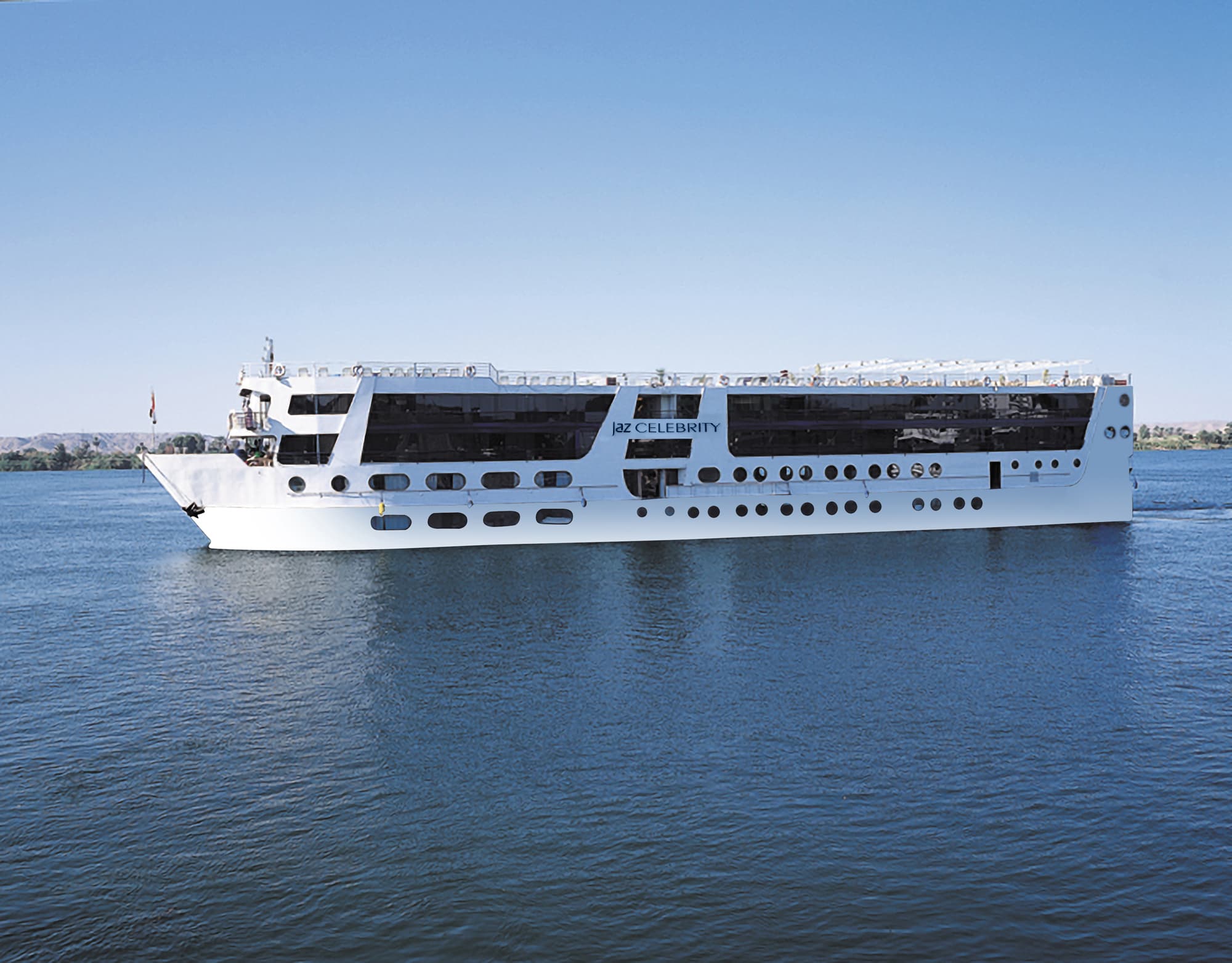
Jaz is the Nile cruise arm of JAZ Voyages, part of Travco Group, and runs the largest fleet in our directory: twelve ships on the Luxor–Aswan route plus three Farouz El Nil dahabiyas.
By TiE Editors6 min read
Nile Cruise for the 2027 Solar Eclipse (Aug 2): Sail Egypt's Totality
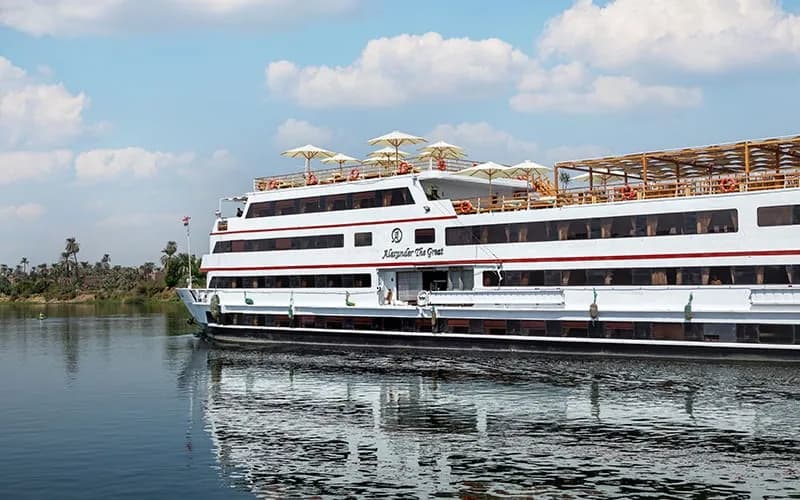
On 2 August 2027 a total solar eclipse passes over Luxor with 6+ minutes of totality. A Nile cruise is the best way to see it — in the path, accommodation solved. How eclipse sailings work and why to book early.
By TiE Editors5 min read