Cave Church Cairo (2026): Mokattam and City of the Dead
How to visit Cairo's Cave Church in Mokattam: the route through Manshiyat Naser, services, etiquette, safety and a guided City of the Dead visit (Oct 2026).
Quick answer: Yes, you can visit the Cave Church in Cairo. It is the Monastery of St Simon the Tanner (Deir Samaan al-Kharraz), carved into the rock of the Mokattam hills above Manshiyat Naser, the Zabbaleen recycling district that outsiders call Garbage City, about 4 km east of Tahrir Square in a straight line. Go in daytime with a guide or a driver who knows the route, dress modestly, and ask before you photograph anyone. We could not confirm official 2026 visiting hours or an entry fee, because the monastery's website was offline when we checked, so confirm both with your guide the day before.
Checked 17 October 2026 against the Cairo Governorate, Egyptian state media, the press, UK and US government travel advice and the monastery's archived pages. Dollars are approximate, at about 52 EGP to the dollar.
Cave Church quick facts
| What we found (checked 17 October 2026) | |
|---|---|
| Where | At the top of Manshiyat Naser, at the foot of the Mokattam cliffs, east of the Citadel and the Northern Cemetery. |
| Hours | No official 2026 visiting hours published; the monastery's website did not load. Plan a daytime visit and confirm with your guide. |
| Services | The Thursday evening General Meeting appears to continue in 2026: a General Meeting video dated 10 September 2026 is listed for the monastery's Facebook page in search results. Other times come from its last archived timetable (copies saved in 2019 and May 2021; it may be older). |
| Entry | No source we could rely on states a ticket price or says entry is free. The monastery says the money it collects goes mainly to upkeep and its ministry projects. |
| Dress | Modest: shoulders and knees covered, closed shoes for the streets (our advice; the UK Foreign Office advises modest dress across Egypt). |
| Photos | Ask first. The UK Foreign Office, citing Ministry of Tourism rules, says you need an Egyptian's written permission before photographing them and that photographing children is prohibited. |
| Time needed | Listed tours run from about 3 to 4 hours (Manshiyat Naser, Cave Church and Northern Cemetery) to a 6-hour private day; allow at least half a day. |
| Getting there | About 9 km by road from Tahrir, roughly 12 minutes in empty traffic on a routing estimate; allow much longer at busy hours. |
What the Cave Church is
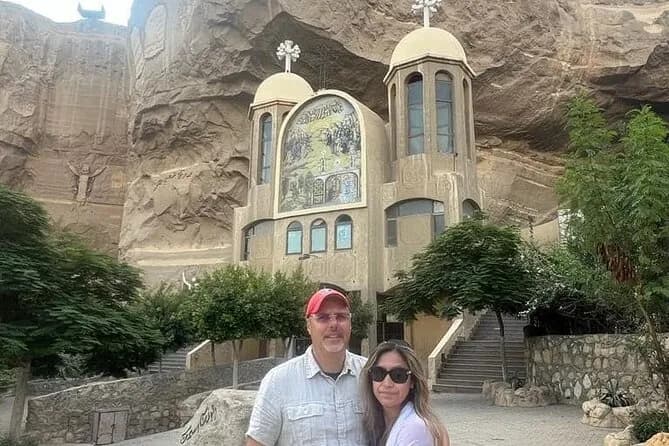
The Cave Church is a working Coptic Orthodox monastery, not a museum. Its main space, the Cathedral of the Virgin Mary and St Simon, is an open amphitheatre cut under an overhang of the Mokattam cliffs. Egyptian state broadcaster Maspero, reporting on the Cairo governor's visit on 6 August 2026, said the church holds about 20,000 people and contains 76 carved images, counted six Orthodox churches in the monastery and called it one of the capital's important tourist destinations.
The name comes from St Simon the Tanner (Samaan al-Kharraz), a 10th-century shoemaker whose prayers, in Coptic tradition, moved the Mokattam mountain; the monastery dates the miracle to 979.
In 1969 the Cairo governor moved the city's waste collectors, most of them Christian, to the Mokattam hills (Egyptian Geographic). A church ministry began in 1972 and the cave was first visited in 1974. Residents cleared rock for years (more than 2.5 million stones, says the Cairo Governorate), and the cathedral got its fixed amphitheatre seating in 1994. The priest behind it, Father Samaan Ibrahim, served the community for about 50 years and died on 11 October 2023.
The other cave churches and the carvings
Ask your guide about the smaller churches too; we could not confirm whether all are open outside services. From the monastery's archived pages:
- St Mark's Church and St Simon Hall: a two-level cave with mosaic panels below and a hall for about 2,000 under carved biblical panels above.
- Church of Anba Paula: found in 1986, first liturgy in 1991.
- Church of Anba Abraam ibn Zur'a: the smallest church in the monastery, first liturgy in 1993.
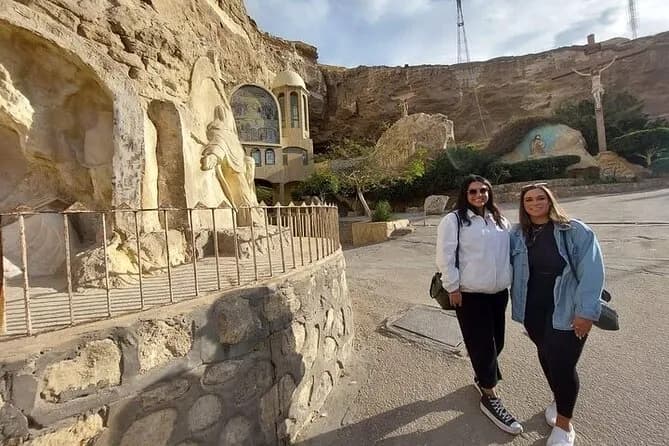
- The cathedral relief: a Virgin and Child projecting from the cathedral's rock ceiling, with St Simon's relics shrine to the right of the altar.
The rock carvings were begun in 1995 by a Polish artist Youm7 names only as Mario.
How to get to the Cave Church: the route through Manshiyat Naser
The last stretch of road runs through Manshiyat Naser. You have three sensible options:
- A guided tour with hotel pickup. Most tours we list include hotel pickup in an air-conditioned vehicle; on some the guide is an optional extra, so check the option you book includes one. Some drive through the recycling quarter without stopping.
- A driver who waits for you. Your own pace, and no hunt for a ride back.
- A visit arranged by the church. The monastery's FAQ (last archived 2021) said visitors could book a guided tour through its administration office; ask your hotel or guide to check this still applies.
In the narrow lane between the neighbourhood and the caves, you pass families sorting and processing material. In 2016 the artist eL Seed painted a mural, Perception, across dozens of buildings in Manshiyat Naser that reads correctly only from one spot on the mountain; we could not confirm its condition in 2026, so ask your guide whether it can still be seen.
When to go: services and quieter times
The monastery is a place of worship first. The only service that appears to continue in 2026 is the Thursday evening General Meeting, with vespers and a sermon. The times below come from the monastery's last archived timetable (copies saved in 2019 and May 2021; it may be older), so confirm them:
- Thursday: a liturgy 06:00 to 08:30 in the morning; the General Meeting 18:30 to 20:30 in the evening (Youm7 gave 7pm in 2023).
- Friday: a liturgy 07:30 to 11:00.
- Sunday: liturgies 06:00 to 08:30 and 07:30 to 11:00.
For the carvings in quiet, our advice is a weekday daytime visit outside these slots. To see the church full, go to a Thursday evening or Sunday morning service, sit at the back and keep your camera away.
Etiquette and photos
- Dress: cover shoulders and knees, and wear closed shoes.
- People: the UK Foreign Office, citing Ministry of Tourism rules, says you need an Egyptian's written permission before photographing them and that photographing children is prohibited. In Manshiyat Naser people are at work and at home: ask, accept a no, and never photograph through doorways.
- The recycling streets: the same UK Foreign Office page (checked 17 October 2026) warns it is illegal in Egypt to take or share photos that could be considered damaging to the country's image, so keep your camera away in the recycling streets unless your guide and the people there say yes.
- Churches: the Foreign Office notes that photographing religious buildings can be sensitive. Ask your guide or someone at the monastery before taking pictures inside, and never during a service.
The Zabbaleen and the recycling district
The Zabbaleen are a mostly Coptic Christian recycling community whose families came to Cairo from Upper Egypt from the 1920s, collecting the city's waste to feed pigs and to sell as scrap. The Christian Science Monitor put the community at about 70,000 people in January 2023, within the much larger working district of Manshiyat Naser.
The Monitor reported that more than 14,000 tons of mixed waste pass through it every day, about 85 percent of Cairo's total. JSTOR Daily wrote that the Zabbaleen recycled up to 80 percent of what they gathered, and that their system took two blows: private waste contracts in 2003 and the 2009 order to cull their pigs over swine flu fears.
Residents dislike the "garbage city" label. One told the Monitor: "this isn't a city of garbage, this is a recycling city." We use their framing on this page, and we ask you to as well.
One local NGO, the Association for the Protection of the Environment (APE), runs a children's centre whose income for families comes from patchwork, rugs and quilts made from garment-factory scraps (Christian Science Monitor, 2023). We could not confirm whether it receives visitors in 2026; ask your guide.
Is it safe to visit Manshiyat Naser and the Cave Church?
Yes, with normal precautions. The UK Foreign Office (updated 4 August 2026) says crime in Egypt is generally low, warns that touts and scammers target tourists, and does not list Cairo among the areas it advises against visiting. The US State Department rates Egypt Level 2, "Exercise Increased Caution" (advisory dated 14 July 2025, still current when we checked on 17 October 2026); its do-not-travel areas are North and Middle Sinai, the Western Desert without a licensed tour company, and border areas, not Cairo. Both governments list religious sites among potential terrorist targets, and the US advisory names churches and monasteries and says security is generally present at such sites; expect checks at the gate. The tourist police number is 126.
Go in daytime with a guide or a church-arranged visit. We found no recent reputable report on the walking route itself, another reason not to wander in alone.
Visiting Cairo's City of the Dead with a guide
Cairo's City of the Dead is a medieval necropolis about four miles long at the foot of the Mokattam hills, dating back to the 7th century and home to hundreds of thousands of living people (The Conversation, April 2026). It is part of Historic Cairo, a UNESCO World Heritage Site, and its Northern Cemetery lies below the same Mokattam hills, so it pairs naturally with the Cave Church. For its history, read The Conversation's April 2026 piece.
Go with a guide: this is an active cemetery and people's home, and a guide knows the lanes between the Mamluk monuments most visitors come for:
- Funerary complex of Sultan Qaitbay (1470s): a mosque-madrasa and mausoleum under a carved stone dome. The conservation firm ARCHiNOS reports starting EU-funded work on it in July 2023; we could not confirm it has finished, so expect scaffolding.
- Khanqah of Faraj ibn Barquq (early 15th century): twin minarets and twin stone domes.
- Also nearby: the khanqah-mausoleum of Sultan Barsbay and the complexes of Sultan Inal and Amir Qurqumas.
Two cautions. We found no 2026 hours or fees for these monuments. And since 2020, road projects have cleared parts of Cairo's historic cemeteries; The Conversation (April 2026) reported that campaigners temporarily halted some demolitions in 2024, including parts of the Northern Cemetery around the Qaitbay complex, but that demolition work began again later that year. None of our listed tours names Qaitbay or Barquq as a stop, and some only drive past the cemetery, so if the monuments matter to you, say so when you book.
Combine it with Coptic Cairo or Islamic Cairo
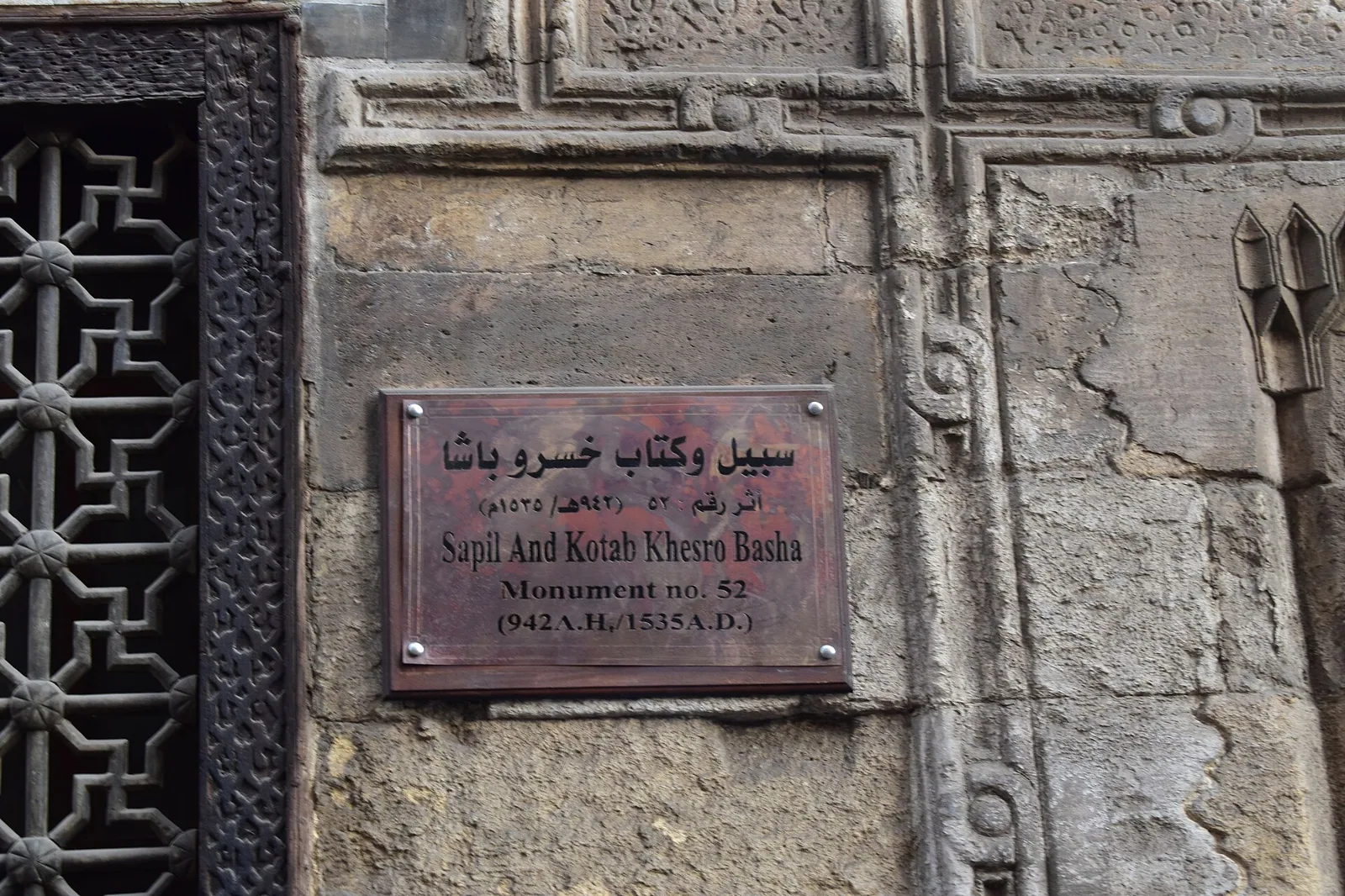
The obvious pairing for a church visit is Old Cairo's churches: the Hanging Church, Abu Serga, Ben Ezra and the Coptic Museum. Our Coptic Cairo guide covers them, and the most-reviewed tour on this route, the Cave Church and Old Cairo churches tour (4.6 from 201 reviews), does both.
If the City of the Dead's Mamluk domes catch you, carry on to Islamic Cairo and Khan el-Khalili or the Cairo Citadel, which sits below the Mokattam hills. For lunch, see our authentic Cairo restaurants; for more, the best things to do in Cairo.
Cave Church and City of the Dead tours: what they cost
Lowest listed price per person on This is Egypt, checked 17 October 2026. Dollars are approximate, at about 52 EGP to the dollar.
| Tour | What it covers | From |
|---|---|---|
| Cave Church and Old Cairo churches | Cave Church plus Coptic Cairo; 4.6 from 201 reviews | EGP 785 (~$15), lowest option; a guide may cost extra |
| Private half day: City of the Dead and Ibn Tulun | About 4 hours, Egyptologist guide, hotel pickup | EGP 1,943 (~$37) |
| Manshiyat Naser, Cave Church and City of the Dead | 3 to 4 hours; itinerary lists all three | EGP 2,354 (~$45) |
| Private half day: Cave Church, Manshiyat Naser and City of the Dead | Lunch included; Manshiyat Naser and the City of the Dead are drive-pasts | EGP 3,467 (~$67) |
| Private full day: City of the Dead and Cave Church | 6 hours | EGP 6,361 (~$122) |
| Islamic Cairo walking tour | For the Mamluk side of the day; 4.5 from 86 reviews | EGP 1,764 (~$34) |
Our 11 City of the Dead tours ran from EGP 1,943 to 7,427 per person (about $37 to $143) on 17 October 2026; see them all on the Cairo destination page.
If you would rather have one private guide for the Cave Church, Manshiyat Naser and the Mamluk monuments of the Northern Cemetery, at your own pace, send us your date and group size on WhatsApp and we will put a day together for you.
What's On in Egypt
Events in Cairo

Egypt Press Photo Exhibition
Tahrir Cultural Center (AUC) · Downtown (Wust El Balad)
Kathak Classical Dance Company- India
Cairo Opera House · Zamalek

Amal Maher Concert
Cairo Opera House · Zamalek
A real team available 24/7 to assist you — free
Seif and the team reply on WhatsApp 24/7 — trip questions, custom plans and booking help.
Ask Seif on WhatsAppCommon questions
Is the Cave Church in Cairo worth visiting?
Yes, if you are interested in living Coptic Christianity or Cairo beyond the monuments. The Monastery of St Simon the Tanner has a rock-cut cathedral that Egyptian state media said in August 2026 holds about 20,000 people and contains 76 carved images, plus several smaller cave churches. Pair it with Coptic Cairo or the City of the Dead to make a half day.
Is it safe to visit the Cave Church and Manshiyat Naser (Garbage City)?
Yes, with normal precautions. Manshiyat Naser, the Zabbaleen recycling district that outsiders call Garbage City, is a working neighbourhood on the road to the monastery. The UK Foreign Office (updated 4 August 2026) says crime in Egypt is generally low, warns about touts and does not list Cairo among areas it advises against. The US State Department rates Egypt Level 2, Exercise Increased Caution (advisory dated 14 July 2025, still current on 17 October 2026), and its do-not-travel areas do not include Cairo. Both governments list religious sites among potential targets, and the US advisory says security is generally present at them, so expect checks at the gate. Go in daytime with a guide, a driver who knows the route or a church-arranged visit, and ask before photographing anyone. The tourist police number is 126.
Is there an entrance fee for the Cave Church?
We could not confirm one either way. No source we could rely on on 17 October 2026 states a ticket price or says entry is free, and the monastery's website was offline. The monastery says the money it collects goes mainly to upkeep and its ministry projects. Ask your guide, and carry small notes.
What are the Cave Church opening hours?
The monastery has not published 2026 visiting hours that we could find (checked 17 October 2026). The Thursday evening General Meeting appears to continue in 2026. The monastery's last archived timetable (copies saved in 2019 and May 2021; it may be older) also lists liturgies on Thursday 06:00 to 08:30, Friday 07:30 to 11:00 and Sunday 06:00 to 08:30 and 07:30 to 11:00. Plan a daytime visit and confirm with your guide the day before.
What is the history of the Cave Church in Cairo?
It is named for St Simon the Tanner, a 10th-century shoemaker whom Coptic tradition links to the moving of the Mokattam mountain, dated by the monastery to 979. The modern monastery began after Cairo's waste collectors were moved to Mokattam in 1969: a ministry started in 1972, the cave was first visited in 1974, residents cleared rock for years, and the cathedral got its amphitheatre seating in 1994. Father Samaan Ibrahim served the community for about 50 years until his death in October 2023.
How do I get to the Cave Church from downtown Cairo?
By car: it is about 9 km by road from Tahrir Square, roughly 12 minutes with no traffic on a routing estimate, and much longer at busy hours. The road runs through Manshiyat Naser. A tour with hotel pickup or a driver who waits is the easiest option; check the tour option you book includes a guide. The monastery's FAQ (last archived 2021) said visitors could book a guided tour through its administration office; ask your hotel or guide to check this still applies.
Can I take photos at the Cave Church and in Manshiyat Naser?
Ask first, every time. The UK Foreign Office, citing Ministry of Tourism rules, says you need an Egyptian's written permission before photographing them and that photographing children is prohibited. It also warns it is illegal to take or share photos that could be considered damaging to the country's image, so keep your camera away in the recycling streets unless your guide and the people there say yes. Photographing religious buildings is sensitive; never photograph a service.
Why is Cairo's Northern Cemetery called the City of the Dead, and do people live there?
Because it is a vast historic Muslim burial ground whose tombs became homes: a medieval necropolis about four miles long at the foot of the Mokattam hills, where hundreds of thousands of people now live, looking after tombs and running cafes and kiosks (The Conversation, April 2026). This is the real Cairo necropolis, not the fictional Hamunaptra of The Mummy films. Its Northern Cemetery holds Mamluk monuments such as the Qaitbay complex and the Khanqah of Faraj ibn Barquq. Visit with a guide.
How much does a Cave Church or City of the Dead tour cost?
On This is Egypt on 17 October 2026, a guided 3 to 4 hour tour of Manshiyat Naser, the Cave Church and the City of the Dead started at EGP 2,354 per person (about $45), and the private 6-hour day we link to was EGP 6,361 (about $122). A Cave Church and Old Cairo churches tour started at EGP 785 (about $15), but that is the lowest option and a guide may cost extra. Dollars are approximate at about 52 EGP to the dollar.
Book it on This is Egypt
Turn this guide into a trip






Egypt's bestsellers
The experiences travelers book most, across the country




Keep reading
Hurghada Diving (2026): Best Sites, Packages & Prices
Diving in Hurghada — the best reefs (Giftun, Careless Reef, Dolphin House) and Abu Nuhas wrecks, Discover Scuba vs PADI courses, season and water temps, and real 2026 prices.
By TiE Editors7 min read
Hurghada Snorkeling Trips (2026): Best Reefs, Prices & How to Choose
Where to snorkel from Hurghada in 2026 — Orange Bay, Giftun, Mahmya, Utopia and Dolphin House — with boat types, marine life, month-by-month sea temperatures, family tips and real prices from 1,000+ bookable trips.
By TiE Editors7 min read
Egypt Tour Prices by Activity (2026): What Each Type Really Costs
What every type of Egypt experience costs — half day, full day or overnight — as a median and a mid-half range in US dollars, from 12,370 live bookable listings.
By TiE Editors6 min read