
Hatshepsut Temple Tours & Tickets
Browse 248 tours of the terraced temple at Deir el-Bahari in Luxor, starting from 411 EGP (about 8 USD), with an average rating of 4.8 out of 5. Real prices compared across booking platforms and updated for 2026.

Tour di mezza giornata: Valle dei Re, tempio di Hatshepsut e Colossi di Memnone
Tour condiviso di un giorno alla Valle dei Re, Hatshepsut, Memnone e pranzo

Private Half Day West Bank Tour to Valley of the Kings Queen Hatshepsut Temple and Colossi of Memnon

Tour privato di mezza giornata a Luxor Valle dei Re e delle Regine, Hatshepsut
Tour privato di un'intera giornata: Valle dei Re, tempio di Hatshepsut e altro

Hurghada: Luxor Karnak, Hatshepsut e la Valle dei Re

VIP Luxor 4 - Ore Private Valley Kings, Tempio di Hatshepsut e pranzo

Valle dei Re e delle Regine, Colossi e tempio di Hatshepsut

Mezza giornata sulla riva occidentale di Luxor: Valle dei Re e tempio di Hatshepsut con biglietti, transfer e pranzo opzionale

Intera giornata: Valle dei Re e delle Regine, tempio di Hatshepsut e altro

Tour di un giorno all-inclusive alla Valle dei Re, Hatshepsut e Memnone

Tour privato alla riva occidentale: Valle dei Re e tempio di Hatshepsut

Tour privato: riva occidentale di Luxor, Valle dei Re e tempio di Hatshepsut
Luxor: mongolfiera, Valle dei Re e tempio di Hatshepsut
Mezza giornata: Valle dei Re, tempio di Hatshepsut e Memnone
2 giorni: templi di Karnak e Luxor, Valle dei Re, Hatshepsut e Memnone

Mezza giornata: Valle dei Re, tempio di Hatshepsut e colossi di Memnone
Privato: tomba di Tutankhamon, Valle dei Re e delle Regine, Hatshepsut

Luxor: mezza giornata Valle dei Re, Hatshepsut e Memnone

Hurghada: Luxor, Karnak, Hatshepsut e la Valle dei Re
Tour di un giorno: Valle dei Re e delle Regine, tempio di Hatshepsut e altro

Luxor tutto incluso: tour guidato alla riva est o ovest e pranzo

Tour privato di Luxor: Valle dei Re, Hatshepsut e Memnone

Rive est e ovest di Luxor: Valle dei Re, Hatshepsut, templi di Luxor & Karnak
Visiting Hatshepsut Temple: what to know
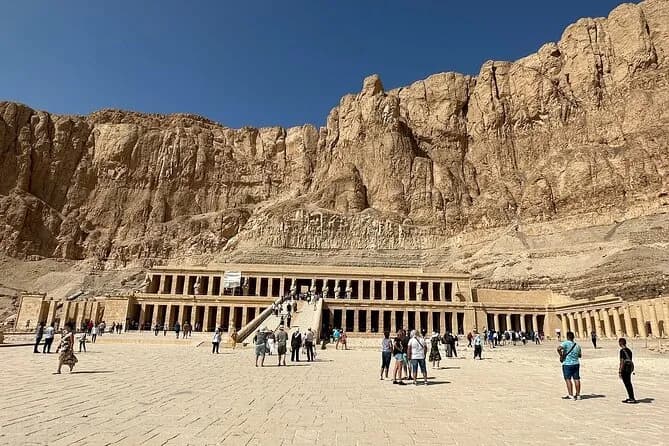
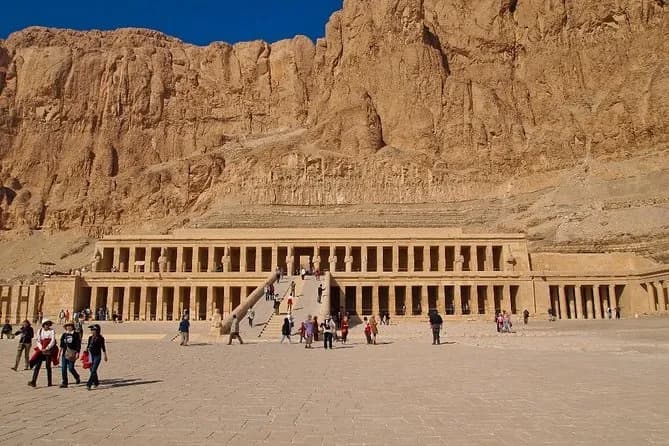
Updated 3 September 2026The mortuary temple of Hatshepsut rises in three colonnaded terraces against a sheer wall of honey-coloured cliff at Deir el-Bahari, on Luxor's west bank, and it looks like nothing else in Egypt. No pylons, no forest of columns: instead, long horizontal porticoes linked by central ramps, set flush into the curve of the rock so that the building seems to grow out of the mountain behind it. The design is nearly 3,500 years old and reads as almost modern. Its ancient name announced the ambition: Djeser-Djeseru, the Holy of Holies.
It was built for one of the very few women ever to rule Egypt as pharaoh, and that fact shapes everything about it. The temple is a legitimacy argument in stone: reliefs proclaiming Hatshepsut's divine birth, a carved record of her great trading expedition to the Land of Punt, rows of statues showing her in the guise of the god Osiris, and, if you look closely, the chisel marks left by a successor who spent years trying to delete her from history. Few buildings anywhere let you read a political story that clearly on their walls.
Most visitors get 40 minutes here as the middle stop on a west bank circuit, between the Valley of the Kings and the Colossi of Memnon, and even that is worth it for the architecture alone. But the temple rewards a slower look, and a little background turns a photo stop into one of the most interesting hours in Luxor. It stands directly opposite Karnak across the river, inside the Theban Necropolis that UNESCO listed in 1979, and the ridge rising behind it is the same rock that hides the royal tombs: her own burial, KV20, was cut from the other side, making temple and tomb the front and back of a single cliff.
The queen who became king
Hatshepsut was the sixth pharaoh of the 18th Dynasty and reigned for roughly 22 years, from about 1479 to 1458 BC. She began conventionally enough, as regent for her young stepson Thutmose III, and then did something almost without precedent: she took the full titles of pharaoh for herself and ruled as senior king, wearing the regalia, running the state and building on a scale most male rulers never matched. She was not the first woman to rule Egypt in her own right, Sobekneferu had done it centuries earlier at the end of the 12th Dynasty, but Hatshepsut made the experiment last, and she left the evidence standing.
Her reign was largely peaceful and built on trade rather than conquest, and she poured its wealth into monuments, including a pair of towering obelisks at Karnak, one of which is still the tallest ancient obelisk standing in Egypt. Deir el-Bahari was the crown of the programme. The temple was designed by Senenmut, her chief steward of Amun, closest adviser and tutor to her daughter Neferure, a courtier so powerful that ancient sources credit him with more than 80 titles. His design did not appear from nowhere: immediately next door stand the ruins of the far older terraced temple of the Middle Kingdom king Mentuhotep II, and Senenmut took that idea and enlarged it into something grander and more symmetrical, three broad terraces climbing about 29.5 metres against the cliff face.
The temple was dedicated chiefly to Amun, the great god of Thebes, but it gathered a cluster of cults under one roofline: chapels for the goddess Hathor and the jackal god Anubis, a chapel honouring her father Thutmose I, and an open altar to the sun god Ra-Horakhty, built roofless on purpose so it would lie under the sky. Its most famous decoration fills the middle terrace. The Punt reliefs record the sea expedition Hatshepsut sent down the Red Sea around her ninth year on the throne: ships being loaded, live myrrh trees carried aboard with their roots intact, incense and exotic animals coming home to Egypt. It reads like an official trade report carved in stone, and it is one of the earliest detailed visual records of a long-distance expedition anywhere. Close by, the Birth Colonnade makes the theological case for her rule, presenting the god Amun as her true father: divine paternity deployed as constitutional law.
Then came the erasure. About two decades after her death, Thutmose III, by then a formidable king in his own right, ordered her names and images attacked. Cartouches were hacked out, statues smashed, her figure chiselled off walls here and on monuments across Egypt; later still, during the Amarna period, Akhenaten's campaign against Amun damaged the temple's imagery a second time. The long delay makes simple revenge an unlikely motive, and succession politics the more probable one, but whatever drove it, the campaign failed in the most literal way: the gaps themselves now tell her story, and you can stand at a wall and watch a pharaoh being deleted and remembered in the same frame.
There is a modern chapter too. The name Deir el-Bahari, Arabic for the Northern Monastery, comes from the Coptic monastery that stood here in the 7th century. The temple was fully excavated between 1893 and 1906 by Edouard Naville, and since 1961 a Polish-Egyptian mission from the University of Warsaw has been conserving and rebuilding it, refitting fallen blocks terrace by terrace; the crisp, legible building you walk through today is the product of that long effort. The site was also the scene of the 1997 attack in which 62 people were killed, the event that transformed security at Egypt's monuments; you will pass through checks on arrival, and the visit today is calm and well organised.
What to see
Start by not walking in. Stop in the lower forecourt, or partway up the first ramp, and take in the whole composition framed by the cliff: this is the classic view and the one photograph the temple really asks for. Early light makes the limestone glow pale gold; by midday it flattens into glare.
Climb the ramps terrace by terrace. On the middle terrace, give real time to the two great relief cycles: the Punt expedition on one side, with its ships, myrrh trees and busy documentary detail, and the Birth Colonnade on the other, where Amun claims Hatshepsut as his daughter. These carvings are the reason to bring a guide, or at least to stand close and read slowly rather than sweeping past on the way to the top.
At the ends of the colonnades hide the temple's best-kept colour. The chapel of Hathor, the goddess shown as a cow or as a woman with cow's horns, and the chapel of Anubis are roofed, inset spaces, so their carving and pigment have survived far better than anything on the sun-blasted open terraces; they are also the coolest corners of the site on a hot morning. Look for the Hathor-headed columns in one and the star-painted ceiling in the other.
The upper terrace is fronted by the Osiride statues: Hatshepsut carved as a pillar in the mummiform pose of Osiris, repeated along the portico, a queen fixed forever in the costume of the god of the afterlife. Beyond lies the sanctuary of Amun, cut back into the living rock of the cliff. As you go, watch the walls for the erasures: gouged cartouches and chiselled-out figures, the Thutmose III campaign visible at eye level once you know to look for it.
Two things first-timers miss. One is the ruined temple of Mentuhotep II immediately to the south, the centuries-older model for the whole design, which almost nobody so much as glances at. The other is the view outward: from the upper terrace the temple's axis runs east across the plain toward the river and Karnak, and that alignment is no accident.
Getting there
The temple stands about 8 km west of Luxor, just off the road that continues to the Valley of the Kings, which is why the two combine so naturally. The crossing logistics are the standard west bank ones: the public ferry and then a taxi, a taxi the long way round over the bridge, or, easiest of all, an organised west bank half-day that strings together the tombs, the temple and the Colossi of Memnon with a guide and air-conditioned transport.
Order matters more than transport. Do the Valley of the Kings first at opening, while its tombs are cool and uncrowded, arrive at Hatshepsut mid-morning, and finish with the Colossi on the drive back toward the river. At the temple itself, a small shuttle runs from the ticket area up the long open approach, a modest convenience that feels like a major one in the heat. For how the west bank fits into a longer Luxor stay, see our guide to things to do in Luxor.
Best time of day
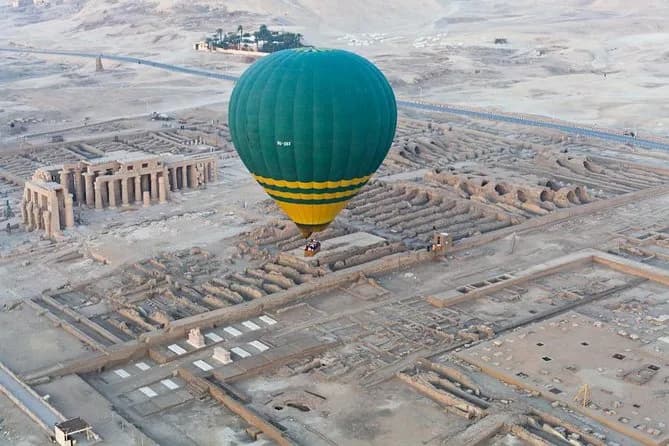
The site opens at 6am, and the temple faces east, so the first hours are everything: low sun on the pale colonnades, long shadows articulating the terraces, and air you can still enjoy. Deir el-Bahari sits in a natural amphitheatre of rock that traps heat, and there is almost no shade once the sun clears the ridge; by late morning the forecourt works like a reflector oven and the cruise-excursion groups are arriving in waves, since the temple is a fixture on every west bank circuit and Luxor mornings run to the cruise timetable. If you want the terraces without crowds in your photographs, be here before 8am. Failing that, the last hour before closing is the quiet fallback, with warm light raking across the cliff, though you trade away the morning glow on the facade. At dawn, look up as well: hot-air balloons cross the necropolis overhead most mornings, and the temple seen from the air is one of the reasons people fly.
Tips for your visit
- Go at opening, or as close to it as your morning allows. Heat and crowds both climb fast, and the early light is the best the temple ever looks.
- An hour to 90 minutes covers it properly, which is why it slots so well between the Valley of the Kings and the Colossi of Memnon.
- Take the shuttle up the approach in warm months and spend the energy you save on the terraces themselves.
- Bring water, a hat and sunglasses: the pale stone doubles the glare. Assume card payment for tickets, as at Luxor's other major sites.
- Seek out the Hathor and Anubis chapels for colour and cool, and give the Punt reliefs ten unhurried minutes.
- Hunt for the hacked cartouches on the upper levels: the erasure campaign is easy to spot once you have found your first one.
- Glance at the Mentuhotep II ruins next door before you leave; the comparison makes Senenmut's achievement obvious.
- It pairs naturally with the Valley of the Kings and the Colossi in one morning; add the Valley of the Queens if your stamina holds.
Other Egypt attractions
Frequently asked questions
How much does it cost to visit Hatshepsut Temple?
Tours and tickets start from 411 EGP (about 8 USD), with a median price of about 2,068 EGP per person.
How many Hatshepsut Temple tours are available?
There are 248 bookable tours and tickets for Hatshepsut Temple.
What is the best Hatshepsut Temple tour?
A top-rated pick is "Tour di mezza giornata: Valle dei Re, tempio di Hatshepsut e Colossi di Memnone".
How long do you need at the Temple of Hatshepsut?
Sixty to 90 minutes covers it properly: the view from the forecourt, the Punt and Birth colonnades on the middle terrace, the Hathor and Anubis chapels and the upper terrace. It is the shortest of the three big west bank stops, which is why it slots neatly between the Valley of the Kings and the Colossi of Memnon.
Can you see Karnak, the Valley of the Kings and Hatshepsut's temple in one day?
Yes, and many full-day tours do exactly that. Start on the west bank at opening with the tombs, take Hatshepsut mid-morning, cross back for lunch and a rest, then do Karnak in the late afternoon when the light softens. If your schedule allows, saving Karnak for the next morning at opening treats all three sites better. Either way it is a long, hot day in summer, so start early and pace yourself.
Was Hatshepsut buried in the temple?
No. Deir el-Bahari was her mortuary temple, built for her cult and memory rather than her burial. Her tomb, KV20, was cut into the Valley of the Kings on the far side of the same cliff, so the temple where she was worshipped and the tomb where she lay were the front and back of one ridge of rock.