Kitesurfing in Egypt (2026): Best Spots, Wind Seasons & Where to Learn
Why Egypt's Red Sea is one of the world's best kite destinations, with every spot compared and 2026 wind stats, named schools and real prices to plan your trip.
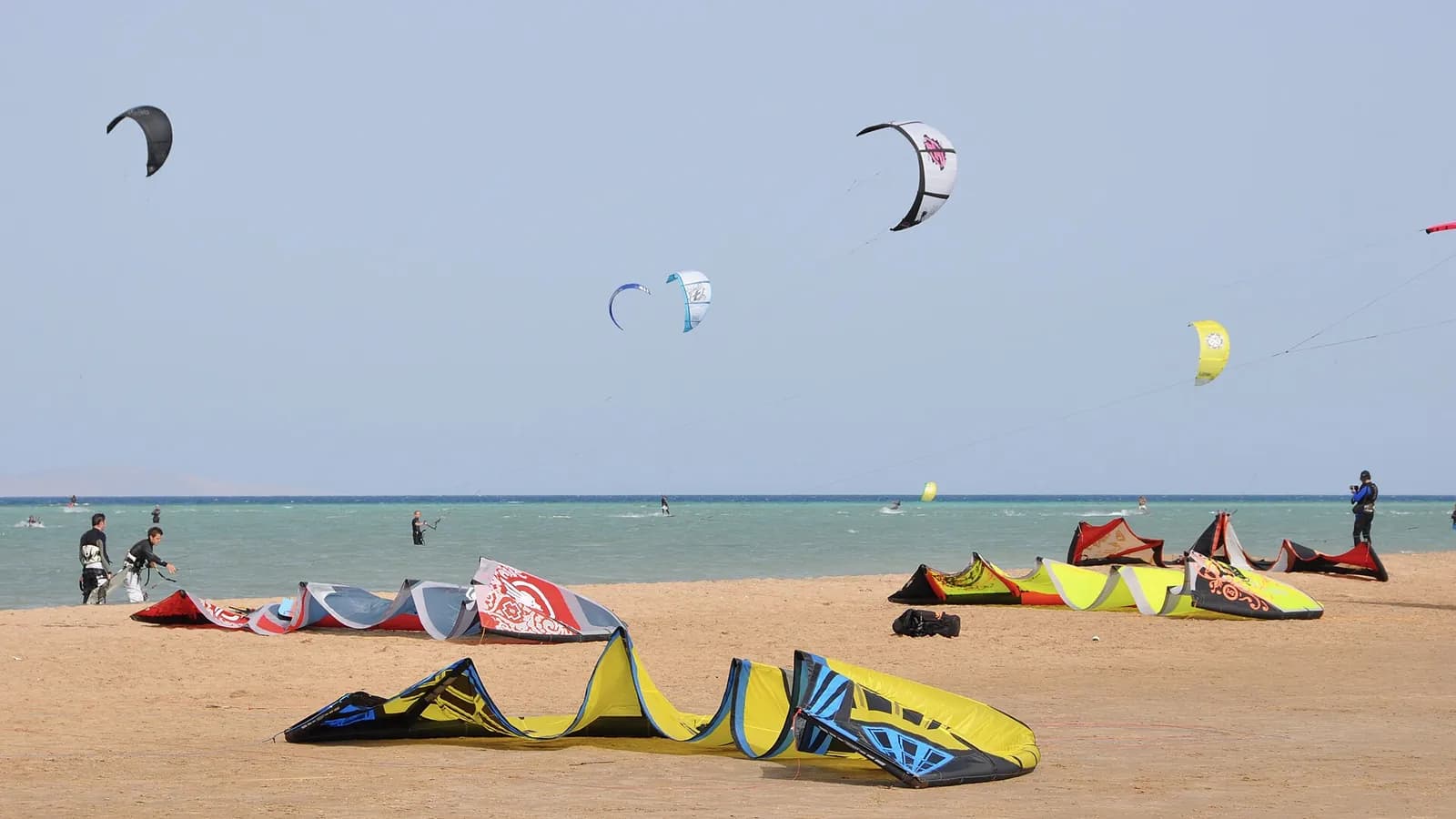
Quick answer: Egypt's Red Sea is one of the world's top kitesurfing destinations, and for beginners it may be the most forgiving place to learn. The reasons are simple: warm water you can ride in a bikini or boardshorts, sunshine almost every day, thermal winds that build like clockwork, and enormous shallow, flat-water lagoons where you stand up and restart instead of drifting downwind. Add low costs, a short flight from Europe and a dense cluster of professional centres, and you can see why riders treat the coast as a winter and shoulder-season home. Here is where to go, when, what it costs, and which spot fits your level.
Why Egypt is a kite mecca
The case rests on a rare combination. The dominant wind is a north-to-northwest flow that runs the length of the Red Sea year-round, reinforced by a thermal sea breeze that draws cooler air off the water as the desert heats up. Much of the best riding happens over man-made or natural lagoons: shin-to-waist deep, flat as a table, warm, and shielded from open water by reef or sandbar. For a beginner that is the whole game. You are never out of your depth, the flat surface keeps the board predictable, and a wipeout ends with you simply standing up. For freestylers and freeriders the same butter-flat water is a trick playground. Add steady side and cross-onshore wind, rescue-boat cover at the offshore spots, low prices and a long list of pro centres within a short transfer of two or three airports, and you have one of the most beginner-friendly kite coasts anywhere.
Wind and weather: how the season really works
The wind here is thermal and terrain-driven, which makes it unusually reliable. The north-northwest flow accelerates as it funnels between the Sinai range and the Eastern Desert; in the narrow Gulf of Aqaba it channels onto Dahab and in the Gulf of Suez onto Ras Sudr, so both gulfs run windier than open coast. A typical day is calm early, builds through late morning, and peaks in the afternoon, so the best sessions run from late morning to sunset.
Strength across the Red Sea sits in the 15 to 25 knot band, with high-summer afternoons touching 25 to 30 knots at the windier spots. For a rider around 75 kg that means a practical quiver of roughly 7 to 12 square metres: a 12 m for 14 to 16 knots, a 10 m for 17 to 20, a 9 m for 21 to 25, and a 7 m for the strong days.
The one rigorously measured dataset comes from Kitepower El Gouna's on-site station, built on four years and more than two million readings, where "rideable" means at least 12 knots for at least two daytime hours. It puts the annual average near 77 percent of days rideable, and it corrects a common assumption: July actually dips.
| Month | Rideable days (El Gouna) |
|---|---|
| January | 63% |
| February | 80% |
| March | 62% |
| April | 65% |
| May | 69% |
| June | 83% |
| July | 63% |
| August | 85% (best) |
| September | 83% |
| October | 81% |
| November | 75% |
| December | 61% |
August is the standout, with June, September and October close behind, while the counter-intuitive July lull surprises many first-timers. Treat these figures as El Gouna-specific: it is the only Egyptian spot with a measured monthly record, so percentages quoted elsewhere are operator estimates. As a rule the northern mainland spots run prime from May to October and stay rideable but lighter (roughly 12 to 18 knots) from December to February; Ras Sudr has the longest season, kiteable February to November; and Dahab and the Sinai gulf peak April to November. The golden weeks of May, June, September and October pair strong wind with warmer water, thinner crowds and less brutal heat. For the wider question of timing a trip, see our guide to the best time to visit Egypt.
What to wear, month by month
Red Sea water at Hurghada and El Gouna runs around 28 to 29°C in August and cools to about 21 to 22°C in February; the Gulf of Aqaba at Dahab is a touch cooler, and the Gulf of Suez at Ras Sudr is the coolest of the three. That translates to a simple wardrobe:
| Season | Water | What to wear |
|---|---|---|
| Summer (Jun–Sep) | ~26–29°C | Boardshorts, bikini or a rash vest |
| Spring / Autumn (Mar–May, Oct–Nov) | ~22–25°C | A shorty most days |
| Winter (Dec–Feb) | ~18–22°C | A full 3/2 mm wetsuit, especially on windy Jan–Feb days |
Many schools lend winter suits, so you rarely need to travel with one.
The spots, in depth
El Gouna, the flagship scene
El Gouna is the busiest kite scene in the country, a short drive north of Hurghada. The main kite beach is Mangroovy: a wide sandy launch, a shallow flat-water zone reaching about 150 m offshore where you stand waist-deep and falls are soft, then deeper, choppier open water out to a reef around 500 m out. It rides best near high tide, because dead low tide shrinks the usable area and exposes reef at the edges. Some centres distinguish the butter-flat El Gouna lagoon, favoured by freestylers and foilers, from the small-chop, cleaner-wind Mangroovy open water. Wind is north-northwest around 90 percent of the time, cross-onshore, building through the morning and holding to sunset.
One practical quirk: there is effectively no independent free-launch in El Gouna. The beach runs as a chain of paid kite stations over roughly 10 km, with a day or beach fee of about €10 to €20 covering launch and land, compressor, storage and often rescue. Every kiter registers with an official centre, and a course taken elsewhere does not automatically grant independent status, because each station runs its own skills check. It suits everyone from first-timers to foilers, and because it is a full resort town it keeps non-kiting partners busy; see our El Gouna guide for the wider town, and our dedicated deep-dive on kitesurfing in El Gouna for a station-by-station breakdown.
Hurghada and Sea Horse Bay
Hurghada shares El Gouna's wind system and makes a cheaper base. The pick for true beginners is Sea Horse Bay, also called Al Ahyaa Lagoon, at the northern end: a huge knee-to-waist sandy lagoon that is about as gentle as learning gets. Magawish, about 20 minutes south, is quieter again. Wind peaks May to September with 27 to 30 windy days a month, and even the leanest mid-November to mid-February stretch still offers around 14. Note that riding or renting independently in Hurghada requires IKO Level 3 or the equivalent. Our Hurghada travel guide covers where to stay and eat.
Soma Bay
An hour south of Hurghada, Soma Bay wraps around a vast, shallow flat-water lagoon, listed by the main operator at roughly 500 by 100 m of sandy, wave-free water, mostly knee to waist deep. It is one of the safest learning environments anywhere. The wind is side-offshore in the morning and swings side-shore around 11:00; because it starts offshore, a rescue and transfer boat service is mandatory, with up to three boats running in peak season. The season is March to November, and days swing from a mellow 15 to 18 knots to 30-plus. This is the connoisseur's beginner coast: less party than El Gouna, more focus on the riding.
Safaga
Safaga sits just south again. ION Club Safaga, at the Imperial Shams resort, pairs a wide shallow flat-water lagoon with an open spot on constant side-offshore wind, gentle enough for beginner mornings and building to around 20 to 25 knots in the afternoon, with a downwind option toward Toubia Island. It is IKO-registered and reads as quieter and cleaner than Soma Bay, though that comparison is experiential rather than measured.
Hamata and Wadi Lahami, the remote deep south
Far down the coast, Hamata offers an enormous flat-water lagoon with a standing area cited at roughly 1 by 2 km, knee to waist deep, crystal-clear and isolated; peak season is May to September at 15 to 25 knots, and summer air can hit 40°C, so a UV top is essential. Wadi Lahami, a protected bay about 10 km south, pairs a sandy beginner lagoon at the beach with a platform to the sea for advanced riders, set among rich marine life at Fury Shoals. Both are shuttle-in spots reached via Marsa Alam airport, and both reward riders who want space, clean water and near-empty beaches.
Ras Sudr, closest to Cairo
On the Gulf of Suez, Ras Sudr is the closest kite coast to Cairo at roughly 2 to 2.5 hours and about 210 km by road. It is a giant beginner playground: two man-made flat-water lagoons plus a large natural one, and at low tide up to 2 km of waist-deep water with constant cross and side-onshore wind over some 15 km of coast; at high tide, kicker waves turn it into one of Egypt's best jumping and freestyle spots. Wind is best March to November at 16 to 25 knots, windiest in late August and September, with better than 80 percent certainty from March to October, though many centres close for winter. There is no nearby airport, so you arrive via Cairo. One important note: Ras Sudr is on the mainland side and is not covered by the free Sinai-only entry stamp, so you need a full Egyptian tourist visa.
Dahab
Over on the Gulf of Aqaba, laid-back Dahab is best known for diving the Blue Hole, but its in-town kite lagoon, beside the Tirana hotel, is a fine flat-water spot: roughly 300 by 500 m, knee to hip deep, separated from the windsurf area by a sandbank. The wind here is offshore, so the lagoon is tide-limited, usable for about four hours in summer and higher through the day in winter. The true Blue Lagoon is a remote, famously flat bay north of town reached by 4x4, boat or a long walk. Wind funnels down the gulf, peaks April to November and usually blows 15 to 30 knots; Dahab has a strong reputation for reliability, though the oft-repeated "hundreds of windy days a year" is a promotional claim, not a measured one. The draw is the vibe: Bedouin cafes, cheap camps, and diving and kiting in one relaxed town. Dahab also qualifies for the free Sinai-only 15-day entry stamp, along with Sharm, Nuweiba and Taba. See our Dahab travel guide for the rest of the town.
Nabq and Sharm el Sheikh
Near Sharm, Nabq Bay is the one genuine kite spot: a large waist-deep flat-water lagoon around 1,500 m wide, protected by an outer reef, roughly 10 minutes from Sharm airport. The rest of the Sharm coast is deep dive terrain, so Nabq is effectively the only real kite lagoon in the area, served by an IKO and CDWS-certified school.
Schools and real 2026 prices
Schools quote in euros and re-price seasonally, so confirm at booking; the figures below are current anchors, with an indicative euro-to-Egyptian-pound rate of about 59 EGP to the euro. "Semi-private" means a maximum of two students sharing an instructor, paired by weight, which is the Egyptian norm and the cheapest way to learn; "private" is one-to-one and fastest.
In El Gouna, Kitepower (an IKO Pro Center, open since 2004) publishes the most detailed list: an 8-hour "Zero to Hero" beginner course runs €465 semi-private or €695 private, and full-set rental is €120 a day, with a €10 day kitepass for those on their own gear. KBC, the F-One centre on Mangroovy, runs an 8-hour beginner course at €439, private hours at €105, and full rental at €109 a day, plus a €35 VDWS licence card. The Duotone Pro Center prices premium beginner tuition at €480 and private hours at €130. Kitepeople lists a 6-hour beginner course at €420.
At Soma Bay, 7BFT KiteHouse is the dominant operator: a 6 to 8-hour beginner course is €340 per person, the 12 to 16-hour "Kitesurfer in 4 Days" package with two rental days is €750, private hours are €98 with gear, and full rental is €129 a day. The Breakers lodge is the kitesurfer-favourite hotel here, with a free shuttle to 7BFT. In the deep south, Wadi Lahami Kitesurfing Center lists an 8-hour beginner course at €390 and full-set rental at €110 a day. At Ras Sudr, Kitesurfing Village publishes a 9-hour beginner course at €298 to €300 and refunds hours lost to no wind or too much wind. In Dahab, Five Squares (open since 2003) is among the best value on the coast, with a 6-hour course at €330, private hours from €55, and rental at €70 a day. At Nabq, The Kite Bubble runs a 12-hour course at €540 in a group or €720 private, with seven-night stay-and-ride packages from €965.
| Item | Typical 2026 range | Anchor examples |
|---|---|---|
| Beginner course (~6–12 h) | €270–520 group/semi; up to €695–950 private | 7BFT €340; Ras Sudr €298 (~17,600 EGP); Dahab €330; Wadi Lahami €390; El Gouna €465 |
| Private lesson / hour | €55–130 | Dahab €55; KBC €105; DPC €130 (~€130 ≈ 7,670 EGP) |
| Full-kit rental / day | €70–150 | Dahab €70; 7BFT €129; DPC €150 |
| Full-kit rental / week | €390–528 | Wadi Lahami €390; 7BFT €429; DPC €528 |
| Storage | €10–22/day; €50–132/week | Dahab €10/day; 7BFT €22/day |
| Beach / day pass (own gear) | €10–14/day | Kitepower €10; KBC €14 |
| Licence card | VDWS €35; IKO record often free with a course | KBC €35 |
The old traveller shorthand that "a couple of hours costs €50 to €60" holds only for a short or kite-only rental; a full two-hour set at a premium centre is closer to €95.
Lessons and certification: IKO vs VDWS
Two credentials dominate. IKO, the International Kiteboarding Organization, is the most widely recognised, skill-based system, with five kiteboarder levels from Discovery through Level 3 (independent, meaning you can ride upwind and self-rescue) up to Evolution. VDWS is the German association's licence, roughly equivalent to IKO Level 3 at its Basic tier, dominant in German-speaking markets and built around a theory step. Crucially, the card records skills but does not guarantee rental anywhere: a receiving centre re-checks your upwind riding and self-rescue and briefs you on local rules before letting you ride independently.
Going from zero to independent typically takes 8 to 12 hours over 3 to 5 days, rarely more than two or three hours a day. Semi-private lessons, capped at two students paired by weight and often coached over Bluetooth helmets, are the norm and the best value per hour. Egypt is one of the most affordable places in the world to certify, thanks to reliable wind, warm flat lagoons, low operating costs and a long season.
Gear and disciplines
Learners usually travel with nothing but swimwear, since lessons bundle the gear; the bulky, size-dependent kites and boards are what you rent. If you want your own fit, the things worth bringing are a harness, a wetsuit or shorty, an impact vest, a helmet, reef booties and strong sun protection. Rental fleets vary by centre: Duotone is common, 7BFT runs Core, and KBC uses F-One. If you fly with your own kit, check the airline's board-bag rules before booking, as allowances differ widely.
As for what you can ride, freeride works everywhere. Flat-water freestyle is strongest at the El Gouna lagoon, Ras Sudr (with three flat lagoons, it is Egypt's freestyle capital), Soma Bay and Hamata; El Gouna is the home spot of Finn Flugel, the 2025 GKA Freestyle World Champion. Egypt is mostly a flat-water country, but Dahab's Napoleon reef and Marsa Alam offer some swell for wave and strapless riding. Light-wind hydrofoiling has a dedicated deeper zone at El Gouna, and downwinders run at Safaga and Soma Bay on the morning offshore breeze toward Tobia Island.
Safety, hazards and right of way
The key hazard is an offshore-wind day, which can carry a rider out to sea and is a firm no-go for beginners. It is exactly why the offshore spots (Soma Bay, Safaga and the Dahab in-town lagoon) run a mandatory rescue-boat service, while most mainland spots such as El Gouna and Ras Sudr sit on safer cross or side-onshore wind. Centres run rescue boats or jet-skis with radio during operating hours only, so there is no riding before or after hours, and self-rescue, meaning depower the kite, flag it, pack down and swim in, is a taught prerequisite for riding independently.
On the water, the basic right-of-way rules apply: starboard tack has priority; on the same tack the upwind kite goes high and the downwind kite goes low; the overtaking rider keeps clear; and anyone coming in to shore or riding a wave gets priority. Keep 50 to 100 m of spacing and never insist on right of way. On the beach, launch and land only at the water's edge with a helper, respect the zoning into beginner, independent and foil areas, and complete registration, briefing and waiver before you ride. Watch for reef cuts (booties help at Soma Bay and Dahab), sea urchins in the Dahab shallows, jellyfish (Red Sea species are non-lethal), strong sun and dehydration, since the wind hides how much you are sweating, and the occasional Khamsin sandstorm in spring.
Kite vs windsurf here
Egypt built its reputation on windsurfing first, and the same flat lagoons and steady thermals suit both sports, so most centres at El Gouna, Soma Bay, Safaga and Dahab teach and rent both. Kitesurfing has the steeper first-day learning curve but a faster payoff and far less kit to travel with; windsurfing is easier to stand up on day one and more forgiving in gusty wind. Nervous beginners facing strong summer wind often start on a windsurf board and switch across once comfortable. On the same beach you can try both and see which one clicks.
Who it suits and how to plan a trip
Beginners are spoilt for choice: El Gouna, Soma Bay, Sea Horse Bay, Ras Sudr, Nabq, Hamata and the Dahab in-town lagoon are all flat, shallow, sandy and warm. Advanced riders gravitate to Ras Sudr and Soma Bay for freestyle, Hamata for space, Dahab for secluded lagoons and a little wave, and El Gouna for foiling beyond the reef. Families and non-kiters do best at El Gouna, a full resort town where the same centres also teach windsurf, wing and SUP, so a partner is never stranded.
The standard trip is a week, which is enough for a beginner to get riding given near-daily wind; two weeks allows real progression, and 10 to 14 days lets you fold in Cairo and the Pyramids or a Nile cruise. Kiting pairs naturally with Red Sea diving, and kite-and-dive weeks are a standard package. For getting there, Hurghada airport serves El Gouna, Soma Bay and Safaga; Marsa Alam serves Hamata and Wadi Lahami; Sharm serves Nabq and Dahab; and Cairo serves Ras Sudr. Remember the visa split: the free Sinai-only 15-day stamp covers Dahab, Sharm, Nuweiba and Taba, but Ras Sudr and the mainland Red Sea coast need a full tourist visa.
A real team available 24/7 to assist you — free
Seif and the team reply on WhatsApp 24/7 — trip questions, custom plans and booking help.
Ask Seif on WhatsAppCommon questions
Where is the best kitesurfing in Egypt?
El Gouna near Hurghada has the biggest kite scene and a huge beginner-friendly lagoon at Mangroovy Beach. Soma Bay is arguably the safest place to learn on one vast flat lagoon, Ras Sudr is closest to Cairo with the longest wind season, and Dahab offers reliable gulf wind with a laid-back vibe. Hamata and Nabq add quieter flat-water options.
When is the kitesurfing season in Egypt?
The northern Red Sea spots (El Gouna, Soma Bay, Hurghada) run prime from May to October and stay rideable but lighter in winter. Measured El Gouna data makes August the windiest month at about 85% rideable days, with June, September and October close behind and a counter-intuitive July dip. Ras Sudr is kiteable February to November, and Dahab peaks April to November.
Is Egypt good for beginner kitesurfers?
Exceptionally. Shallow, flat-water lagoons at El Gouna, Soma Bay, Sea Horse Bay, Ras Sudr, Nabq and Dahab let you stand up and reset instead of drifting away, the water is warm, and certified schools are affordable. Many riders come to Egypt specifically to learn.
How much do kitesurfing lessons cost in Egypt?
A zero-to-riding beginner course of roughly 6 to 12 hours typically runs €270 to €520 in a group or semi-private, and up to €695 to €950 private. Real 2026 anchors include 7BFT Soma Bay €340, Ras Sudr €298, Dahab €330 and El Gouna €465. Private hours run €55 to €130 and full-kit rental €70 to €150 a day. Confirm at booking, as schools quote in euros and re-price seasonally.
El Gouna or Soma Bay for kitesurfing?
El Gouna has more schools, both lagoon and open-sea riding, and a resort-town social scene, so it suits a varied holiday. Soma Bay is centred on one vast, safe flat-water lagoon with mandatory rescue boats, making it slightly better for pure beginner focus and quieter days. Both are near Hurghada.
Can you kitesurf near Cairo?
Yes. Ras Sudr, on the Gulf of Suez, is about 2 to 2.5 hours from Cairo and has flat, shallow lagoons with one of Egypt's longest wind seasons, kiteable February to November. Note that Ras Sudr is on the mainland side and needs a full Egyptian tourist visa, not the free Sinai-only stamp.
Do you need a wetsuit to kitesurf in Egypt?
In summer and the shoulder months, no: water reaches 26 to 29°C and many riders wear boardshorts, a bikini or a rash vest. In winter (December to February) it cools to around 18 to 22°C and a full 3/2 mm wetsuit is comfortable, especially on windy January and February days. Many schools lend winter suits.
Do I need a licence or certification to kitesurf in Egypt?
To ride or rent independently you generally need IKO Level 3 or a VDWS Basic licence, and the receiving centre still re-checks your upwind riding and self-rescue. In El Gouna every kiter must register with an official centre and there is no free independent launch. Certification is legally required only for instructors, not riders.
Book it on This is Egypt
Turn this guide into a trip

Egypt's bestsellers
The experiences travelers book most, across the country
Keep reading
Hurghada Diving (2026): Best Sites, Packages & Prices
Diving in Hurghada — the best reefs (Giftun, Careless Reef, Dolphin House) and Abu Nuhas wrecks, Discover Scuba vs PADI courses, season and water temps, and real 2026 prices.
By TiE Editors7 min read
Hurghada Snorkeling Trips (2026): Best Reefs, Prices & How to Choose
Where to snorkel from Hurghada in 2026 — Orange Bay, Giftun, Mahmya, Utopia and Dolphin House — with boat types, marine life, month-by-month sea temperatures, family tips and real prices from 1,000+ bookable trips.
By TiE Editors7 min read
Egypt Tour Prices by Activity (2026): What Each Type Really Costs
What every type of Egypt experience costs — half day, full day or overnight — as a median and a mid-half range in US dollars, from 12,370 live bookable listings.
By TiE Editors6 min read