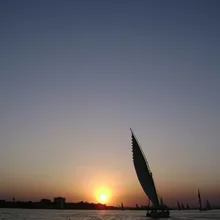
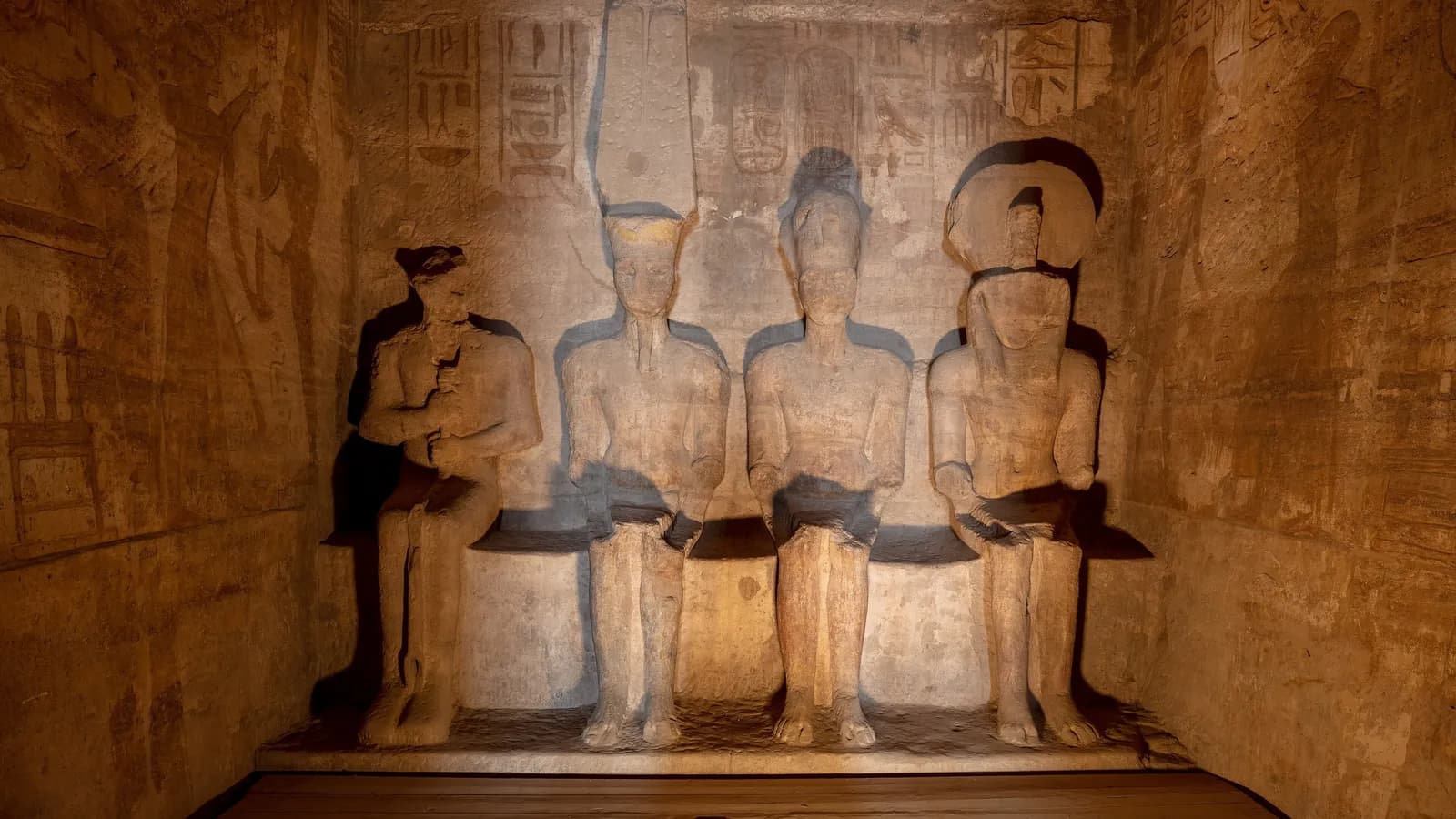
 Photo by Diego Delso (delso.photo), via Wikimedia Commons, CC BY-SA 4.0
Abu Simbel: How to Visit Ramesses II's Great Temples (2026)
Ramesses II carved two temples into a Nubian cliff in the 13th century BC. Here is how to visit them from Aswan, when the sun lights the sanctuary, and how they were moved 65m in the 1960s.
Abu Simbel sits 280 km south of Aswan, near the Sudanese border, on the west shore of Lake Nasser. Ramesses II ordered its two temples cut directly into a sandstone cliff in the 13th century BC, around 1264 to 1244 BC, to mark Egypt's southern frontier and overawe Nubia. The Great Temple's facade carries four seated colossi of Ramesses, each about 20 metres tall, staring east across the water. You reach it by a 45-minute flight or a three-hour road convoy from Aswan, entry runs around 600 to 800 EGP, and two hours on site covers both temples. This is one of the few ancient sites where the first sight of it in person still beats every photograph.
At a glance: Two rock-cut temples built c.1264 BC by Ramesses II, 280 km south of Aswan; the Great Temple has four 20m colossi and a solar alignment on 22 February and 22 October; the whole complex was cut into 1,000-plus blocks and moved 65m higher in the 1960s. Reach it by 45-minute flight or 3-hour road convoy; budget 2 hours on site.
Two feats of engineering, 3,000 years apart
The ancient feat is the alignment. The Great Temple runs about 60 metres back into the cliff, and on two mornings a year the rising sun travels the full axis to light three of the four gods seated in the innermost sanctuary. Ptah, a god linked to the underworld, stays in shadow by design. Egyptologists read the dates as marking the king's birthday and coronation.
The modern feat matched it. When the Aswan High Dam began filling Lake Nasser in the 1960s, the rising water was set to drown both temples. A UNESCO-led team of engineers from several countries sawed the entire complex into more than 1,000 blocks weighing up to 30 tonnes each, lifted them, and rebuilt everything 65 metres higher and around 200 metres back from the old shoreline between 1964 and 1968. They also raised a domed concrete mountain behind the Great Temple to carry the load and recreate the cliff. The joins are almost invisible on site today, which is the point: you would never guess the whole thing had moved.
What you will see
The Great Temple of Ramesses II dominates. One of the four colossi lost its head and torso to an ancient earthquake, and the fallen pieces still lie at its feet where they dropped. Inside, a hall of eight Osiris pillars leads toward the sanctuary, and the walls carry Ramesses' version of the Battle of Kadesh against the Hittites, the propaganda campaign that later produced the first surviving peace treaty in history.
The Temple of Hathor, cut into the same cliff a short walk north, honours Ramesses' chief queen, Nefertari. Its facade is unusual: Nefertari's standing statues match the king's in height, roughly 10 metres, a status almost never granted to an Egyptian queen, who was normally carved knee-high beside the pharaoh. The painted reliefs inside stay vivid because the rock shelters them from weather.
Before you go in, spend a minute on the setting itself. The temples now face out over Lake Nasser, a vast artificial reservoir that did not exist when they were carved; in Ramesses' day they looked out over the Nile at the edge of Nubia. The water you see is the same water that would have drowned them, held back by the High Dam upstream, which makes standing on the terrace a quiet lesson in what the 1960s rescue actually saved.
Reading the walls inside
Most visitors rush the interiors, but they hold the point of the temple. In the Great Temple's first hall the eight Osiris pillars show Ramesses in the pose of the god of the dead, marking him as divine while still alive. The north wall carries the Battle of Kadesh scenes, where the king is shown alone in his chariot scattering the Hittite army, a version far grander than the actual stalemate the battle produced. Deeper in, the sanctuary seats four gods cut from the living rock: Ptah, Amun-Ra, the deified Ramesses himself, and Ra-Horakhty. In the Temple of Hathor next door the reliefs show Nefertari being crowned by the goddesses Hathor and Isis, a rare honour that signals how much status the queen held.
The Sun Festival
Around 22 February and 22 October the dawn alignment lights the sanctuary, and the town fills for the Sun Festival with music, food stalls and crowds who arrive before sunrise. The light show itself happens just after dawn, roughly 5:30 to 6:30am, and lasts only about 20 minutes as the beam creeps down the 60-metre axis. If your dates line up it is a memorable morning, but the site is packed, tickets sell out well ahead, and you queue in the dark. Many visitors prefer a normal quiet morning instead, when the temples are nearly empty.
How to visit from Aswan
You have three routes, and the trade-off is time versus cost. This is how they compare:
| Route | Time each way | Best for |
|---|---|---|
| Flight (EgyptAir / Air Cairo) | ~45 min | Least tiring; a couple of hours on site, back by lunch |
| Road convoy | ~3 hrs | Cheapest; a long full day with a pre-dawn start |
| Lake Nasser cruise | arrives by water | A rarer approach, passing other rescued Nubian temples |
The flight is the fastest and least tiring, three services a day at peak season, and it gives you roughly two hours on site before the return leg. The road convoy covers the 280 km in about three hours each way, leaving Aswan very early, and runs as a long day trip. A Lake Nasser cruise approaches from the water, a rarer arrival that also passes other rescued Nubian monuments such as Wadi es-Sebua. The road day trip is covered in detail in the Abu Simbel day trip from Aswan guide.
What it costs
The temple entry ticket is around 600 to 800 EGP for a foreign adult (roughly half for students with ID), paid by card. That is separate from getting there. In our catalogue, a full Abu Simbel day trip from Aswan starts from about 3,466 EGP (around 71 USD) for a shared road tour and climbs toward 9,650 EGP and up for private flight-based tours with a guide. Flights alone from Aswan can start near 90 to 130 USD return depending on the date. If you are already paying for a guide in Aswan, the flight tour is the one to book for comfort; the convoy is the budget option if you do not mind the 4am start.
Practical tips
Go as early as you can. Flight and convoy arrivals cluster in mid-morning, so the first hour after opening gives softer light and the colossi nearly to yourself. The Great Temple faces east, so early light hits the four colossi head-on, which is also the best time for photographs of the facade. Bring your passport, since this is a border zone with checkpoints, plus water, sun cover and a card for the ticket. There is very little shade and almost no food beyond the visitor-centre kiosk, so eat before you arrive or carry snacks, especially on the long convoy day. Exterior photography is free, but interior photos need a separate ticket, so decide before you go in. Two hours is enough for both temples at a relaxed pace, and the small visitor centre has an exhibit on the 1960s rescue worth ten minutes. Abu Simbel is the natural southern end of an Aswan trip and a fixed highlight of the 10-day Egypt itinerary. Many travellers reach Aswan by boat first; see the Nile cruise from Aswan to Luxor guide for that leg, or browse Aswan and Abu Simbel experiences to book the flight or convoy that suits your dates.
Common questions
How do you get to Abu Simbel from Aswan?
By a 45-minute flight (fastest, about two hours on site), an early-morning road convoy of roughly three hours each way as a long day trip, or a Lake Nasser cruise that reaches the temples from the water. Abu Simbel is 280 km south of Aswan.
How much does Abu Simbel cost to visit in 2026?
The temple entry ticket is around 600 to 800 EGP for a foreign adult, about half for students, paid by card. Getting there is separate: in our catalogue a full day trip from Aswan starts from about 3,466 EGP for a shared road tour, with private flight-based tours running higher. Return flights alone from Aswan start near 90 to 130 USD depending on the date.
How old are the Abu Simbel temples?
Ramesses II had them carved in the 13th century BC, around 1264 to 1244 BC. The Great Temple carries four seated colossi of the king about 20 metres tall; the smaller temple honours Queen Nefertari.
What is the Abu Simbel Sun Festival?
Around 22 February and 22 October, dawn sunlight travels the Great Temple's 60-metre axis to light three of the four gods in the sanctuary, leaving Ptah in shadow. The show happens just after sunrise, roughly 5:30 to 6:30am, draws big crowds and celebration, and lasts about 20 minutes.
Were the Abu Simbel temples really moved?
Yes. Between 1964 and 1968 a UNESCO-led team cut the complex into more than 1,000 blocks of up to 30 tonnes and rebuilt it 65 metres higher and about 200 metres back to escape the rising waters of Lake Nasser, adding a concrete dome behind the Great Temple. The joins are almost invisible today.
Should I visit Abu Simbel by flight or by road?
Fly if you can. The 45-minute flight avoids the pre-dawn start and the six hours of driving, leaving you fresh for the temples. The road convoy is cheaper but means leaving Aswan around 4am for three hours each way. A Lake Nasser cruise is a slower, scenic third option.
How long do you need at Abu Simbel?
About two hours covers both the Great Temple and the Temple of Hathor at a relaxed pace. Arrive at opening for softer light and thinner crowds before the mid-morning flights and convoys arrive.
Do you need a passport to visit Abu Simbel?
Yes, carry your passport. Abu Simbel is a border zone near Sudan with security checkpoints on both the road and at the airport, so bring your passport for the trip along with water, sun cover and a card for the entry ticket.
Book it on This is Egypt
Turn this guide into a trip
Luxor Day Trip from Hurghada Small Group & Tutankhamun Tomb

Tour to Pyramids & The Grand Egyptian Museum

Hot Air Balloon Ride in Luxor Egypt with Transfers Included
Keep reading
Hurghada Diving (2026): Best Sites, Packages & Prices
Diving in Hurghada — the best reefs (Giftun, Careless Reef, Dolphin House) and Abu Nuhas wrecks, Discover Scuba vs PADI courses, season and water temps, and real 2026 prices.
By TiE Editors7 min read
Hurghada Snorkeling Trips (2026): Best Reefs, Prices & How to Choose
Where to snorkel from Hurghada in 2026 — Orange Bay, Giftun, Mahmya, Utopia and Dolphin House — with boat types, marine life, month-by-month sea temperatures, family tips and real prices from 1,000+ bookable trips.
By TiE Editors7 min read
Egypt Tour Prices by Activity (2026): What Each Type Really Costs
What every type of Egypt experience actually costs — from a 1,700 EGP camel ride to a 48,500 EGP Nile cruise — based on 29,710 real bookable tours across seven platforms.
By TiE Editors6 min read