
Temple of Edfu Tours & Tickets
Browse 127 visits to the best preserved temple in Egypt in Aswan, starting from 104 EGP (about 2 USD), with an average rating of 4.7 out of 5. Real prices compared across booking platforms and updated for 2026.
Edfu And Kom Ombo Temples Private Tour From Luxor

Private Luxor to Aswan Trip with Guide & Stops at Edfu & Kom Ombo

Luxor to Edfu & Kom Ombo Temples with Aswan Transfer

Luxor to Aswan or Vice Versa with Edfu & Kom Ombo Temples

Private Full Day Tour to Esna, Edfu and Komumpo Temples from Luxor
From Luxor: Private Day Trip to Edfu and Kom Ombo

Edfu Kom Ombo Day Trip
Day Trip to Edfu & Kom Ombo temples from Luxor and drop off in Aswan or Luxor

Day Tour From Luxor to Aswan Esna Edfu, Philae temple
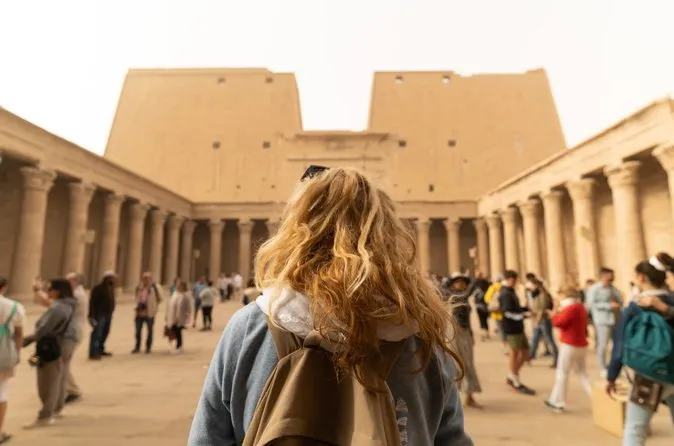
Edfu and Kom Ombo Day Tour with Aswan Transfer from Luxor
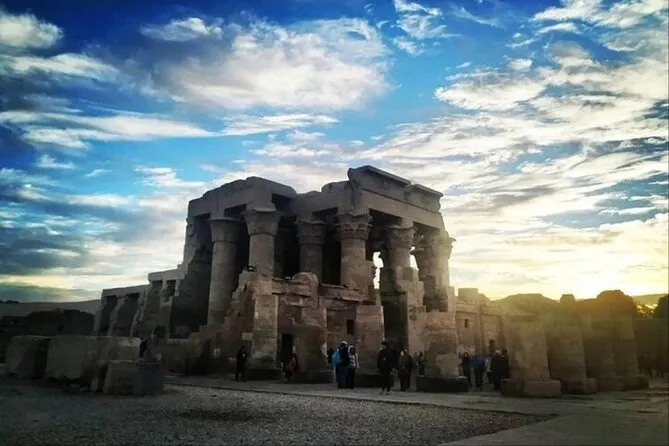
Luxor Aswan Private tour Esna Khnum, Edfu Horus Kom-Ombo Temples
Private Luxor–Aswan Transfer with Edfu & Kom Ombo (or vice versa)
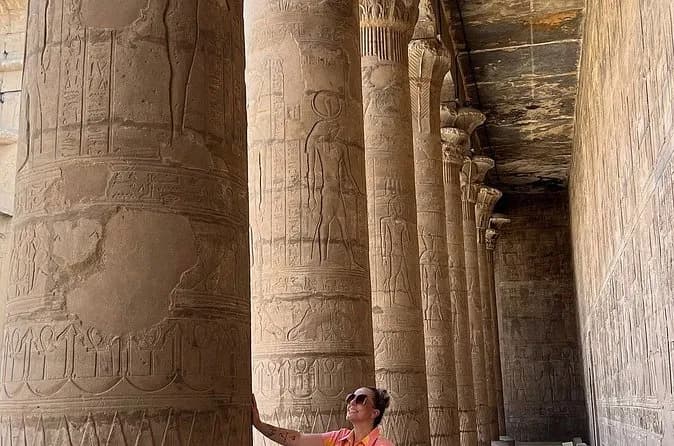
Luxor to Aswan Private Tour with Expert Guide Edfu Temple Tickets
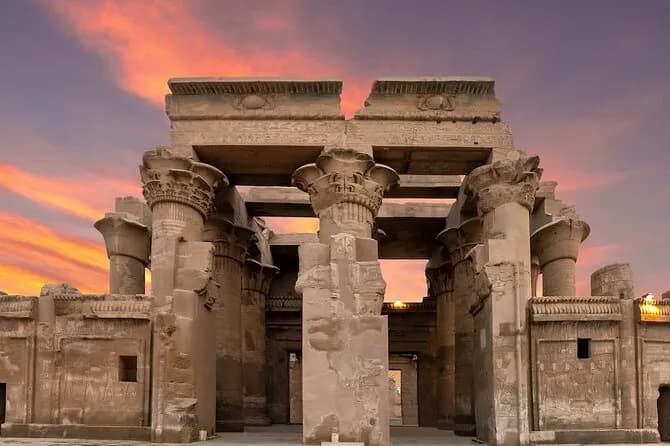
Private Edfu & Kom Ombo Tour with Aswan Transfer

3 Days 2 Night Nile Cruise Includes Visits to Edfu & Kom Ombo from Luxor
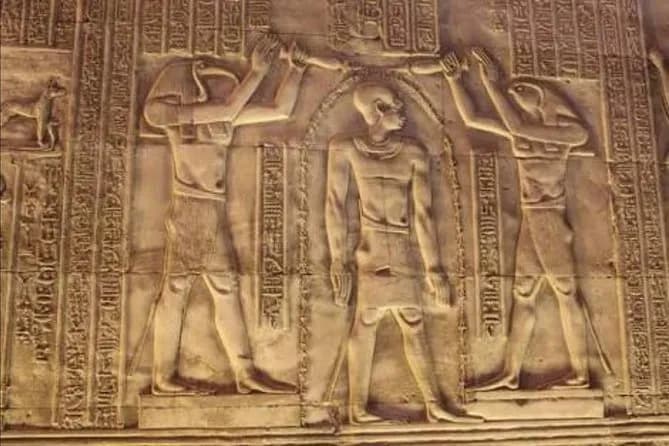
Private trip to Edfu and Kom Ombo Temples from Luxor
Private Tour to Edfu and Kom Ombo from Luxor
Day Tour to Edfu and Kom Ombo from Luxor
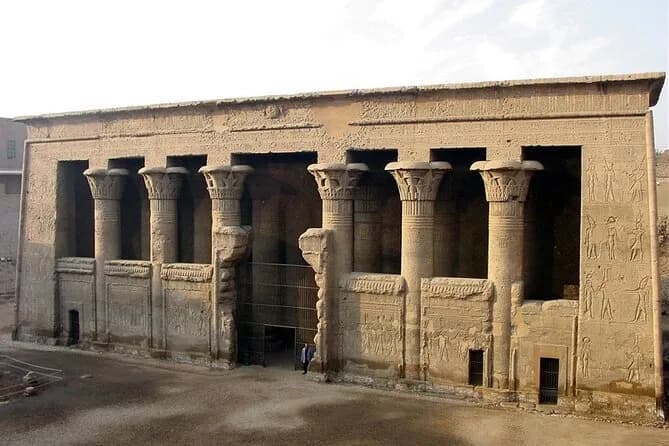
Private tour to Edfu & Kom Ombo Temples from Luxor
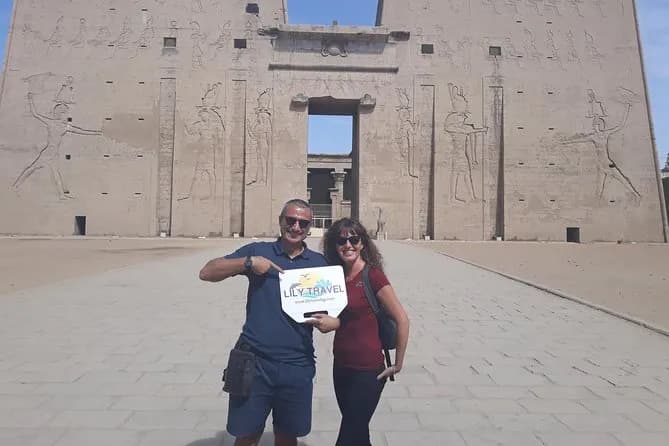
Edfu and Kom ombo private tour from Luxor or Aswan

Luxor: Edfu and Kom Ombo Private Guided tour, lunch& Felucca

Full day to Esna ,Edfu, Komampo temple's from Luxor

Private Transfer Luxor to Aswan (Edfu & Kom Ombo if Selected)

Transfer From Luxor To Aswan And Stop At Edfu Kom Ombo Temples
Visiting Temple of Edfu: what to know
Updated 26 September 2026Edfu is the most complete ancient temple left standing in Egypt, and the reason is almost absurd: it spent the better part of two thousand years buried. Desert sand and Nile silt crept up the walls until only the tops of the pylon showed, and a village grew on the mound above, its houses sitting directly on the roof of the sanctuary. What would have been quarried away for building stone, as happened to so many other temples, was instead sealed in. When Auguste Mariette began clearing it in the 1860s, what emerged was a temple with its roof intact, its doorways square, its columns standing and its walls covered in text from floor to ceiling.
The Temple of Horus took about 180 years to build, from 237 BC under Ptolemy III to 57 BC under Ptolemy XII, which makes it young by Egyptian standards. That youth is exactly why it matters. By the Ptolemaic period the priesthood was writing everything down, partly out of scholarly instinct and partly because Greek rulers needed instructions to perform Egyptian rites correctly. The result is a temple whose walls explain the temple: how it was founded, how the rituals ran, what was kept in which room, which festivals fell on which days. Egyptologists reconstruct ceremonies at far older sites by reading the answers off these walls.
For a visitor, the effect is different from Karnak and worth preparing for. Karnak overwhelms you with scale and ruin. Edfu does something rarer: it gives you a roof over your head, a dark axis running back to a sealed sanctuary, and the sense of a building that still works.
Getting there on a cruise, which is how most people arrive
Almost every Luxor to Aswan cruise stops at Edfu, and the arrival is part of the experience. Boats moor on the Nile and the temple sits a couple of kilometres inland, so the transfer is traditionally by calèche, a horse-drawn carriage, through the town. Drivers line up at the mooring and the ride takes ten to fifteen minutes each way.
Two things are worth knowing. First, the stop is usually early, often before breakfast, because the fleet arrives together and everyone wants the temple before the heat. That early start is a gift: the light in the forecourt at eight in the morning is the best light of the day. Second, the condition of the horses varies and some visitors find the ride uncomfortable to watch. If that matters to you, ask your boat about a minibus instead; most can arrange one, and it is a reasonable thing to request.
If you are not on a cruise, Edfu sits roughly halfway between Luxor and Aswan and is an easy stop by road, usually paired with Kom Ombo in one long day.
What you are actually looking at
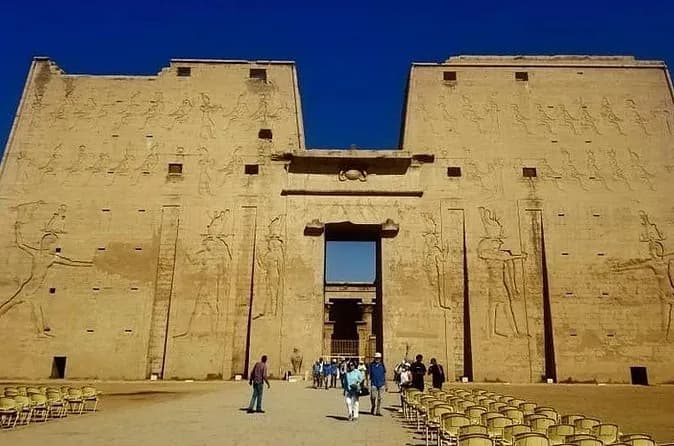
Approach through the forecourt and the first thing you meet is the pylon, a pair of enormous sloping towers flanking the entrance, still carrying their full height and their carved scenes of the king smiting enemies before Horus. It is among the largest and best preserved pylons anywhere in Egypt.
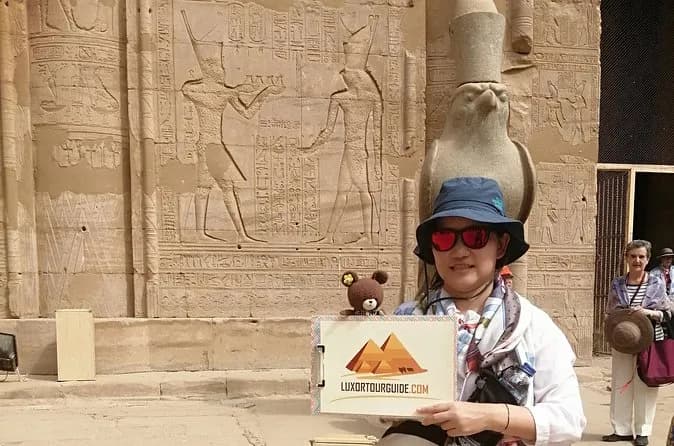
In front of it stands the statue people photograph: a falcon in black granite, wearing the double crown, poised and slightly haughty. That is Horus, and this is his house. A second falcon stands further in. They are the most recognisable objects on the site and the reason so many Edfu photographs look alike.
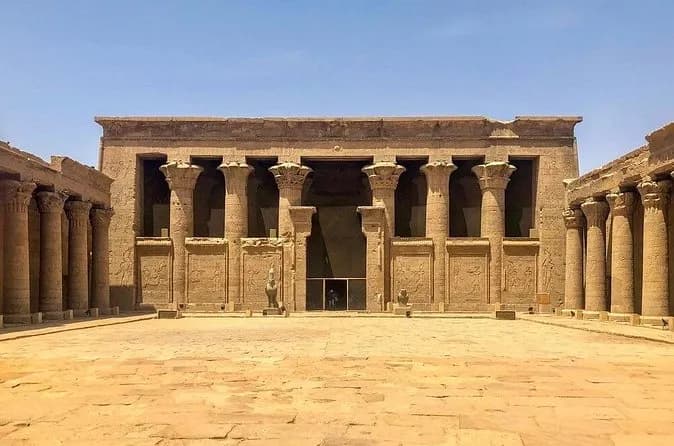
Pass the pylon into the peristyle court, a broad open square ringed with columns whose capitals are all different, palm and lotus and papyrus alternating in a way that feels almost playful. Beyond it the temple goes dark. The outer hypostyle hall, then the inner one, then a series of smaller chambers, each a little lower and a little tighter than the last, until you reach the sanctuary at the back.
The sanctuary is the point of the whole building. In it stands a polished granite shrine, made under Nectanebo II and therefore older than the temple around it, which held the cult statue of the god. In front of it sits a replica of the sacred barque, the portable boat in which Horus travelled out of the temple during festivals. Standing there, at the end of the axis, in near darkness, with the building narrowing around you, you get the architectural argument the Egyptians were making: the world gets smaller, darker and more concentrated the closer you come to the god.
Do not skip the corridor that runs around the sanctuary between the inner and outer walls. It is quiet, few groups bother with it, and it carries the Triumph of Horus reliefs, a strip-cartoon of the god spearing Seth, who appears as a hippopotamus, drawn absurdly small so that no one mistakes who is winning. The accompanying text is a ritual drama, closer to a script than a story, performed here annually.
Two smaller rooms reward the detour. One is the laboratory, where the recipes for temple perfumes and incense are carved on the walls, ingredients and quantities and all. The other is the Nilometer, reached from the passage, used to measure the flood and so to calculate taxes. A temple, a pharmacy and a revenue office in one building.
The festival that connects Edfu to Dendera
Once a year, in the summer month of Epiphi, the goddess Hathor left her temple at Dendera and sailed upriver to Edfu to be with Horus. The journey took several days, with stops at towns along the way, and ended in the Festival of the Beautiful Reunion: fourteen days of ceremony, procession and public holiday, during which the two gods were together in the temple and the population of the surrounding country came to celebrate.
This is worth knowing because it turns two separate sightseeing stops into one story. If your itinerary includes both Dendera and Edfu, you are visiting the two ends of the same annual voyage, and the reliefs in both temples show it.
How long to give it, and what first-timers get wrong
An hour and a half is enough to see Edfu properly. Two hours if you walk the outer corridor slowly and look at the laboratory. Cruise itineraries usually allow about that, and unlike at Karnak you will not feel you are leaving half the site unseen.
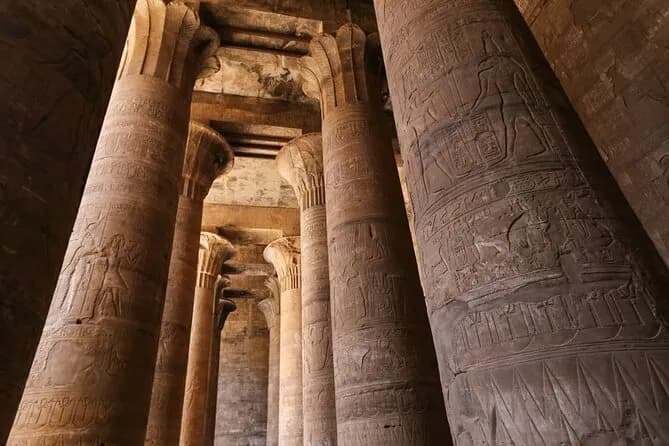
The three things visitors most often miss: the outer corridor with the Horus and Seth reliefs, because groups turn back at the sanctuary; the blackened ceiling in the hypostyle hall, where soot from later inhabitants who lived inside the temple is still visible overhead; and the systematic damage to the faces and hands of figures on the lower walls, done in the Christian period, which is not vandalism in any casual sense but a deliberate neutralising of images still believed to hold power.
Bring water and a hat. The forecourt is fully exposed and the interior, though shaded, is not cool.
Is Edfu worth it if you have already seen Karnak?
Yes, and for a specific reason. Karnak shows you how big Egyptian religion was. Edfu shows you how it worked. You walk the same route a priest walked, through rooms still in the order they were used, under a roof, to a sanctuary that still holds its shrine. No other major temple in Egypt gives you that sequence intact.
If you are choosing between temples on a tight schedule, the honest ranking for a first visit is Karnak for scale, Abu Simbel for spectacle, and Edfu for understanding. Most cruise itineraries give you all three without asking you to choose.
Other Egypt attractions
Frequently asked questions
How much does it cost to visit Temple of Edfu?
Tours and tickets start from 104 EGP (about 2 USD), with a median price of about 5,693 EGP per person.
How many Temple of Edfu tours are available?
There are 127 bookable tours and tickets for Temple of Edfu.
What is the best Temple of Edfu tour?
A top-rated pick is "Edfu And Kom Ombo Temples Private Tour From Luxor".
What is special about the Edfu Temple?
It is the most completely preserved major temple in Egypt. Sand and silt buried it almost to the roof for centuries, which protected the stone from quarrying and weather, so it still has its roof, its columns, its sanctuary shrine and wall texts that run from floor to ceiling. Those texts describe the temple's own rituals and construction, which is why Egyptologists use Edfu to reconstruct ceremonies at far older sites.
Is Edfu Temple worth visiting?
Yes, particularly if you have already seen a ruined temple such as Karnak. Edfu is roofed and largely intact, so you walk the full axis from the pylon to the dark sanctuary in the order it was meant to be walked. An hour and a half covers it comfortably.
What is the Temple of Edfu made of?
Sandstone, quarried locally, with a granite shrine in the sanctuary that predates the surrounding building and two black granite falcon statues of Horus at the entrance.
How do you get to Edfu Temple from the Nile cruise dock?
The temple is a couple of kilometres inland from the mooring. The traditional transfer is by calèche, a horse-drawn carriage, taking ten to fifteen minutes each way. Most boats can arrange a minibus instead if you prefer.
How long does Edfu Temple take to visit?
Ninety minutes is enough to see it properly, two hours if you walk the outer corridor and look at the laboratory reliefs. Cruise stops typically allow about that.