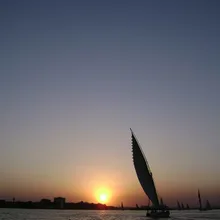
The night sky
Stargazing in the White Desert
The White Desert has one of the darkest skies within reach of Cairo: no towns for tens of kilometres, dry air and clear nights most of the year. For the most stars, go within three or four days of a new moon; in the 2026-27 season those fall around 9 November, 9 December, 7 January, 6 February, 8 March and 6 April. The Geminid meteor shower in mid December is the best of the camping season, and on 2 August 2027 a total solar eclipse crosses the area.
2026-27 season
New moon dates to plan around
- 9 November 2026
- 9 December 2026
- 7 January 2027
- 6 February 2027
- 8 March 2027
- 6 April 2027
- 6 May 2027
Dates are rounded to the day in Egypt time. The few nights either side are almost as dark, because the thin moon sets early in the evening or rises just before dawn. Around the full moon the stars fade, but the chalk rocks glow white under the moonlight, which is its own spectacle.
Shooting stars
Meteor showers in the camping season
- 1Leonids, around 17 November. A modest shower; nice if it falls near a new moon.
- 2Geminids, around 13 to 14 December. The strongest shower of the year, with dozens of meteors an hour from a dark site. Cold, so dress for it.
- 3Quadrantids, around 3 to 4 January. Short and sharp, best before dawn.
- 4Lyrids, around 22 April. A smaller spring shower.
What you see
The Milky Way and the winter sky
In the cool months the evening sky is dominated by Orion, the Pleiades and Sirius, with the fainter winter band of the Milky Way overhead. The bright core of the Milky Way rises before dawn from about March and is high in the evening by late spring and summer. From the White Desert you can also see Canopus, the second-brightest star, low in the south, which never rises for most of Europe.
Astrophotography
Photographing the stars
A recent phone in night mode on a small tripod can capture the stars over the chalk formations. With a camera, use a wide lens, the widest aperture, ISO 1600 to 3200 and exposures of 15 to 25 seconds, and focus manually on a bright star. A head torch on low red light lets you see without spoiling everyone's night vision. See photography in the White Desert.
2 August 2027
The 2027 total solar eclipse
The path of the total eclipse of 2 August 2027 crosses Bahariya and the Black Desert, where totality lasts about six minutes around midday local time. Totality shortens further south, to a few minutes at the White Desert formations, and Farafra town falls just outside the path. August is very hot, so plan shade and water. See 2027 eclipse times for every place in Egypt.
Asked often
Stargazing, answered
- Is the White Desert good for stargazing?
- Yes, it is one of the darkest skies within reach of Cairo, with no towns nearby and dry, clear air most nights.
- When is the best time for stars in the White Desert?
- Within three or four days of a new moon, between October and April. Around 9 December, 7 January and 6 February in the 2026-27 season are good examples.
- Can I see the Milky Way?
- Yes. In winter you see the fainter winter Milky Way overhead; the bright core rises before dawn from about March and is best in late spring and summer.
- Do I need a telescope?
- No. The naked eye is enough to see thousands of stars. Binoculars add a lot if you have them.
- Is the White Desert in the path of the 2027 eclipse?
- Yes. Bahariya and the Black Desert get about six minutes of totality on 2 August 2027; the formations further south get a few minutes; Farafra town is just outside the path.