Before you book
Ten things to know before you book a dahabiya
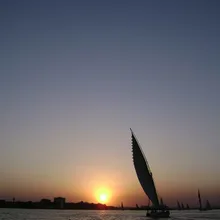
A dahabiya is a small Nile sailing boat of four to twenty cabins, and it is a different trip from a cruise ship. It sails when the wind allows and takes a tow when it does not, starts at Esna rather than Luxor, stops at sites the big ships pass by, and trades a pool and a show for space on deck and quiet. Here is what guests most often wish they had known.
1. You sail when the wind allows, and take a tow when it does not
A dahabiya has no engine of its own, or only a small one. When the north wind blows, the crew raise the sails and the boat glides upriver in near silence. When it drops, which it often does, a small tug pulls or pushes the boat so the trip keeps to time. Guests on boats such as Nora say the tow took nothing away from the trip, but if sailing is the point for you, ask how much of your route is usually under sail.
The wind is most reliable from October to April, which is also the most comfortable season for the temples.
2. Most trips start at Esna, not Luxor
Most dahabiyas sail the reach between Esna and Aswan, where the river is quiet and the small sites are. Esna is about an hour’s drive south of Luxor, and the transfer is usually included. Karnak and the Valley of the Kings are seen on the Luxor day before or after. Boats such as Iris and the Sonesta Amirat dahabiyas start in Luxor itself.
3. You stop where the big ships cannot
Dahabiyas moor at islands and riverbanks and visit El Kab, Gebel el-Silsila and Nubian villages such as Daraw that cruise ships pass by. At Edfu and Kom Ombo, small groups often arrive outside the coach-party rush. See the sites only dahabiyas reach.
4. Cabins vary more than you think
Every dahabiya cabin faces the river, but sizes range widely. Standard cabins on some ten-cabin boats are about 9.5 square metres; on The Orient they are about 17, on Iris about 20 and on Sonesta Amirat Dahabeya II 25 to 35. The best cabins are usually the suites at the stern, often with a private terrace, as on Loulia and Lazuli Highness.
5. Alcohol is rarely included, and some boats do not sell it
Water, tea and coffee are standard, and soft drinks often are. Alcohol almost never is. Some boats have a bar; others, such as Iris, sell no alcohol at all and are happy for you to bring your own. Ask which kind your boat is, and buy wine or beer in Luxor before you board if needed.
6. You will probably share a table
With ten to twenty guests, meals are often served at one shared table, on deck or in the salon. Most guests enjoy it. If you would rather not, book the whole boat: on the smallest dahabiyas, that is only five or six cabins. See what a whole boat costs.
7. A jacuzzi is more likely than a pool
Only a few dahabiyas have a pool: Iris has a heated one and Akhnaton a small plunge pool. The Lazuli boats and the Sonesta Amirat dahabiyas have a jacuzzi or hot tub on the sun deck. Most boats have neither a gym nor a spa; Sonesta Amirat Dahabeya II has both.
8. Wi-Fi is basic
Many boats list Wi-Fi, but on the river it is slow and drops out between towns. Buy an Egyptian eSIM or local SIM before you board; mobile data is usually better than the boat’s connection.
9. Expect stairs, and steep banks
Dahabiyas have two or three decks joined by steep stairs, and moorings on natural banks can mean a gangplank and uneven steps. Sonesta Amirat Dahabeya II is the rare dahabiya with a lift to every level. If stairs are hard for you, see Nile cruising with limited mobility.
10. Winter mornings on deck are cold
From December to February the dawn temperature in Luxor averages about 7 to 9 °C, and the open deck is colder with a breeze. Pack a warm layer and, for evenings at riverside moorings, insect repellent. Days are warm and sunny. See when to go.
From our fleet data
What is included, boat by boat
Across the 109 dahabiyas we track, full board, temple tickets and an Egyptologist are almost always included. Alcohol and crew tips almost never are.
| Item | Included | Not included | Not stated |
|---|---|---|---|
| Full board (all meals) | 99 | 1 | 9 |
| Water and soft drinks | 33 | 12 | 64 |
| Alcohol | 2 | 45 | 62 |
| Egyptologist guide | 83 | 0 | 26 |
| Temple entrance fees | 84 | 2 | 23 |
| Transfers | 79 | 7 | 23 |
| Shore excursions | 66 | 6 | 37 |
| Crew tips | 11 | 63 | 35 |
| Service and taxes | 57 | 0 | 52 |
| Wi-Fi | 18 | 1 | 90 |
| Flights | 3 | 33 | 73 |
| Visa | 0 | 11 | 98 |
Prices run from about US$140 to US$1,500 per person per night. To choose a boat, start with the best dahabiyas by what you want.
Asked often
Dahabiyas, answered
- Do dahabiyas actually sail?
- Yes, when the wind allows. Dahabiyas are sailing boats, and when the north wind drops a small tug tows them so the trip keeps to time. How much of a trip is under sail depends on the wind and the season, so ask the boat what to expect on your dates.
- Is alcohol included on a dahabiya?
- Almost never. Water, tea and coffee are standard and soft drinks often are. Some dahabiyas have a bar; others sell no alcohol and let you bring your own.
- Do you tip on a dahabiya?
- Yes. Of the 109 dahabiyas we track, 63 say crew tips are not included and only 11 include them. Ask for the suggested amount when you book, bring it in cash, and give it at the end of the trip.
- Where does a dahabiya cruise start?
- Most start at Esna, about an hour's drive south of Luxor, and end in Aswan, or the reverse. A few, including Iris and the Sonesta Amirat dahabiyas, start in Luxor.
- How much does a dahabiya cost?
- About US$140 to US$1,500 per person per night, depending on the boat, the cabin and the season. Full board, temple tickets and an Egyptologist guide are usually included.