

Dendera & Abydos Temple Day Tours from Luxor, Egypt
Visit the vividly painted astronomical ceiling at Dendera and the exquisite Osiris reliefs at Abydos on a full-day tour from Luxor, far from the crowds.
26 esperienze

Transfer privati da Luxor a Hurghada (visita a Dendera opzionale)

Mezza giornata privata: tempio di Dendera da Luxor

Tour di un giorno ai templi di Dendera e Abydos da Luxor

Escursione giornaliera da Luxor ai templi di Abydos e Dendera (privata)

Mezza giornata privata al tempio di Dendera da Luxor

Tour privato di un giorno ai templi di Dendera e Abydos da Luxor

Luxor: escursione ai templi di Dendera e Abydos

Mezza giornata privata al tempio di Dendera da Luxor

Tour privato guidato di un giorno ai templi di Dendera e Abydos con feluca da Luxor

Transfer privato da Luxor a Hurghada con visita al tempio di Dendera

Tour di un giorno ai Templi di Dendera e Abido da Luxor

Tour di mezza giornata al Tempio di Dendera da Luxor

Escursione giornaliera ai templi di Abydos e Dendera

Tour di un giorno intero ai due templi di Abydos e Dendera
Escursione privata di un giorno ai templi di Dendera e Abydos

Tempio di Dendera: tour privato di mezza giornata

Mezza giornata privata: tempio di Dendera da Luxor

Tour privato a Dendera e Abydos da Luxor

Transfer privato da Luxor a Hurghada

Tour privato di un'intera giornata: templi di Dendera e Abydos da Luxor

Tour privato di mezza giornata al Tempio di Dendera da Luxor

Transfer da Luxor a Hurghada con il tempio di Dendera

Transfer privati da Luxor a Hurghada (visita facoltativa di Dendera)

Escursione di un giorno al tempio di Dendera da Luxor

Tour privato Visita i templi di Dendera e Abydos da Luxor

Tour privato di un'intera giornata: Dendera e Abydos da Luxor
The Temple of Hathor at Dendera
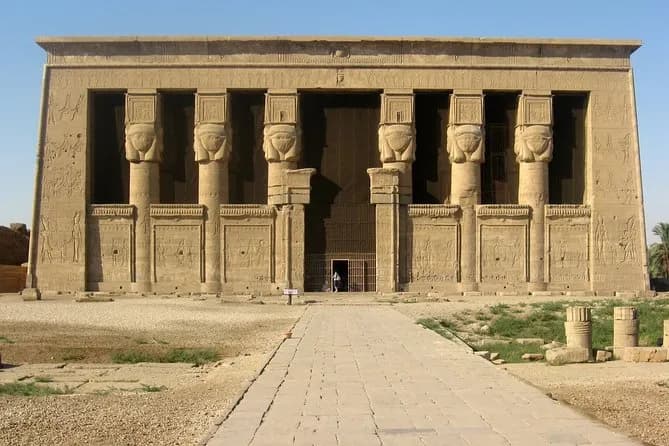
Dedicated to the goddess of love, music and joy, the Temple of Hathor at Dendera is one of the best-preserved temple complexes in all of Egypt. Because it was built comparatively late, largely under the Ptolemies and finished under Roman emperors, and because it lay buried under sand and town rubble for centuries, its stone roof and painted ceilings survived largely intact. Step into the hypostyle hall and look up: the famous astronomical ceiling, a dense map of constellations, decans and zodiac figures, still carries traces of its original blue and gold pigment. A replica of the celebrated Dendera Zodiac sits on the ceiling of a rooftop chapel (the original relief was removed to the Louvre in the 19th century). Narrow stairways lead up to the roof kiosk and down into a network of crypts, where priests once stored sacred treasures and cult statues behind walls carved with unusually fine, deeply cut reliefs.
The Temple of Seti I at Abydos
An hour or so further north, Abydos was Egypt's most sacred pilgrimage site, long believed to be the burial place of Osiris, god of the afterlife. The Temple of Seti I, completed by his son Ramesses II, is often ranked among the finest relief work to survive from ancient Egypt: raised and sunk carvings of extraordinary delicacy, still holding pigment in places, cover walls dedicated to seven chapels for different gods. In a corridor off the temple, the Abydos King List records the cartouches of 76 pharaohs recognized by Seti I as legitimate predecessors, a chronology that has helped Egyptologists reconstruct the sequence of dynasties (with a few politically inconvenient rulers, such as Akhenaten and Hatshepsut, conspicuously left out). Behind the main temple lies the Osirion, a mysterious, massive structure sunk below the water table and built in an archaic style that has fueled decades of debate over its true age.
A Long Day from Luxor, Usually Combined
Both sites sit north of Luxor along the Nile, roughly three hours' drive each way, so visiting either one already fills most of a day. Combining both into a single trip is the standard, more efficient approach, since the road to Dendera passes near Abydos. Expect an early departure, several hours in a private vehicle along the Qena road, time at both temples, and a return to Luxor by early evening. It is a long day in the car, but that same distance is exactly what keeps both sites free of the tour-bus crowds that fill Luxor's East and West Banks.
Why the Extra Miles Are Worth It
Nowhere else in Egypt do you see this much original color and this much intact stonework at once. Karnak and Luxor Temple are grander in scale, but millennia of exposure stripped most of their paint and toppled their roofs; Dendera and Abydos kept both. For travelers who want to understand how a temple actually looked and functioned, rather than piece it together from ruins, these two sites are unmatched. For deeper background on the mythology and history behind both temples, see our Abydos & Dendera guide.
Planning Your Visit
October through April offers the most comfortable temperatures for the highway drive and time spent walking the sites; summer heat on the open road can be intense. A knowledgeable guide is especially valuable here, since neither site has much on-site signage, and the astronomical ceiling, the King List and the Osirion all reward context. Bring water, sun protection and a flashlight for the Dendera crypts. Pair this trip with time in Luxor itself; our Luxor travel guide covers the Valley of the Kings, Karnak and the West Bank for the rest of your stay.
Domande frequenti
How long does the Dendera and Abydos day tour take from Luxor?
Most tours run 10-12 hours round trip from Luxor, including roughly three hours' driving each way plus time exploring both temples.
Can Dendera and Abydos be visited separately?
Yes, but since both lie along the same road north of Luxor, almost all tours combine them into one full-day trip rather than running two separate excursions.
Is the zodiac ceiling at Dendera the original?
No, the relief now in the rooftop chapel is a plaster replica; the original carved zodiac was removed in the 19th century and is displayed at the Louvre Museum in Paris.
What is the Abydos King List?
A carved inscription in the Temple of Seti I listing the cartouches of 76 pharaohs recognized as legitimate predecessors, an important source for reconstructing Egyptian chronology.
Is a guide necessary to appreciate these temples?
Not required, but strongly recommended, since there is little on-site signage and a guide can explain the astronomical ceiling, the crypts, and the Osiris cult reliefs in context.
Is the road from Luxor to Abydos and Dendera safe to travel?
Yes, the route is regularly used by tour operators, and organized day trips travel with experienced drivers familiar with the road and current conditions.