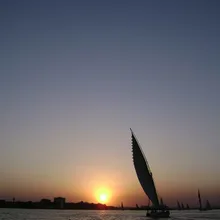
Nature on the river
Birdwatching on the Nile
The Nile between Luxor and Aswan is one of the easiest places in the world to watch birds: a green ribbon of reeds, fields and islands through the desert, used by resident herons, egrets and kingfishers and by European birds wintering in Africa. In a week you can expect pied kingfishers, egrets, herons, Egyptian geese, spur-winged lapwings, hoopoes and the Nile Valley sunbird. November to February adds the winter migrants. A sailing dahabiya is the best platform, because it moves slowly, quietly and close to the bank.
What you will see
Ten birds you will almost certainly see
| Bird | Where and how |
|---|---|
| Pied kingfisher | Black and white, hovering over the water before diving. The Nile's signature bird, seen all day. |
| Cattle egret and little egret | White herons in the fields and on the banks, often following buffalo and farmers. |
| Grey, purple and squacco herons | Standing still in the reeds; the squacco is small and buff, the purple hides deep in cover. |
| Egyptian goose | On sandbanks and islands, in pairs and families. |
| Spur-winged lapwing | Noisy black, white and grey wader on every sandbank. |
| Hoopoe | Pink-brown with a crest and black-and-white wings, in temple grounds and village gardens. |
| Nile Valley sunbird | A tiny sunbird found almost nowhere else, in flowering trees in Aswan and on the islands. |
| African pied wagtail | At home on the rocks and islands around Aswan. |
| Black kite | Circling over towns and the river all day. |
| Glossy ibis | Dark, with a curved bill, in flocks over the fields in winter. |
When to go
The best months
Resident birds are there all year. From November to February European birds such as wagtails, warblers, waders and birds of prey winter along the river, and the weather is at its best for long hours on deck. March and April bring spring migrants passing north. Early morning and the hour before sunset are the busiest times.
The best platform
Why a dahabiya is best for birds
- 1Slow and quiet. Under sail there is no engine to scare birds off, and the boat moves at walking pace.
- 2Close to the bank. Dahabiyas moor at islands and sandbanks that big ships pass at a distance.
- 3A low deck. You sit a few metres above the water, at eye level with the reeds.
- 4Time. Four or five nights between Esna and Aswan against two or three on a ship.
In Aswan, a felucca or small boat around the islands of the First Cataract adds the rocky river habitat. See do dahabiyas really sail? and the best dahabiyas.
Kit
What to bring
Binoculars for each person, a field guide to the birds of Egypt or the Middle East, and a camera with a zoom lens. Dahabiyas run about US$140 to US$1,500 per person per night. See also photography on a Nile cruise.
Asked often
Birds on the Nile, answered
- What birds can you see on a Nile cruise?
- Pied kingfishers, cattle and little egrets, grey, purple and squacco herons, Egyptian geese, spur-winged lapwings, hoopoes, black kites and the Nile Valley sunbird, plus winter migrants from Europe between November and February.
- When is the best time for birdwatching on the Nile?
- November to February, when European birds winter along the river and the weather is pleasant. Early morning and late afternoon are the best times of day.
- Is a dahabiya good for birdwatching?
- Yes, the best option. It sails quietly at walking pace and moors close to islands and reeds, so birds are close and undisturbed.
- Where is the Nile Valley sunbird found?
- Along the Nile in Egypt and Sudan; in Aswan it feeds in flowering trees on the islands and in gardens.