How a dahabiya moves
Do dahabiyas really sail?
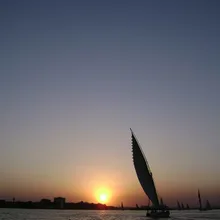
Yes. A traditional dahabiya has no engine of its own and moves under two large lateen sails, helped by the prevailing north wind when sailing south and by the current when sailing north. Because the wind on the Nile often drops, almost every dahabiya travels with a small tug or motorboat that tows it on calm stretches or when the boat must keep to the timetable. Expect a mix: hours of real, silent sailing, and some towing. A few larger boats sail and motor, so ask if pure sail matters to you.
The physics
Sails, wind and current
The Nile flows north, from Aswan towards Luxor and Cairo, while the prevailing wind blows from the north. For thousands of years this let boats drift downstream with the current and sail back upstream with the wind. A dahabiya uses the same trick: its two tall triangular sails catch the north wind when heading south from Esna or Luxor to Aswan, and the current carries it north.
The hours under sail are what guests remember: no engine hum, the creak of the rigging, and the riverbank sliding past at walking pace.
On calm days
The tug or motorboat
Most dahabiyas list an accompanying motorboat or tug for calm-wind days. It travels alongside and tows the dahabiya when the wind drops, when the boat is sailing against the wind, or when it needs to reach a mooring before dark or a temple before it closes. Guests on Hadeel mention being towed when the wind drops, and that is normal.
When the tug is working you hear a low engine from the tug, not from your own boat. Ask the captain to cut it when the wind rises; most will.
For your trip
What it means for your timetable
- 1The route is fixed, the hours are not. Temples and moorings stay the same, but the captain decides when to sail and when to tow.
- 2Sailing south is the purer sail. Esna or Luxor to Aswan runs with the wind, so it usually has more time under sail.
- 3Sandbanks. The river is shallow in places, which is why dahabiyas are flat-bottomed. A captain may wait or take another channel; delays are usually short.
- 4The Esna lock. Most dahabiyas start and finish at Esna, upstream of the lock, so they never queue for it. Boats that start in Luxor pass it like the ships do.
Our picks
Choosing a boat that sails
Small classic boats such as Akhnaton and Loulia spend more of the day under sail. Larger boats such as Iris trade a little of that for more space and a heated pool. Dahabiyas run about US$140 to US$1,500 per person per night. See the best dahabiyas and the Esna lock.
Asked often
Dahabiya sailing, answered
- Do dahabiyas actually sail?
- Yes. Traditional dahabiyas have no engine of their own and move under two lateen sails. On calm days a small tug or motorboat tows them.
- Do dahabiyas have engines?
- Most traditional dahabiyas do not; they travel with a separate tug or motorboat for calm stretches. A few larger, newer boats have their own motors as well as sails.
- What happens if there is no wind on a dahabiya?
- The accompanying tug tows the boat so it keeps to the timetable. Temples and moorings stay the same.
- Which direction is best for sailing on a dahabiya?
- South, from Esna or Luxor to Aswan, because the prevailing wind blows from the north. Sailing north, the current does most of the work.
- Is a dahabiya slow?
- Yes, on purpose. It covers the Esna to Aswan stretch in four or five nights, against two or three for a cruise ship, which is why it can stop at islands and small sites the ships pass by.