 Photo by Caoimheen3, via Wikimedia Commons, CC BY-SA 4.0
Pyramids of Giza: The Complete Visitor Guide (2026)
How to visit the Great Pyramid, the Sphinx and the Giza plateau in 2026: tickets, the inside-the-pyramid add-on, camel rides, best times, and the tours travellers actually book.
The Pyramids of Giza are the one sight almost nobody skips, and the plateau is easier to visit than its reputation suggests. Three pyramids, the Great Sphinx, a row of smaller queens' pyramids and the Valley Temple sit on a single desert shelf on the western edge of Cairo, about 40 minutes from downtown and 20 from the Grand Egyptian Museum. General plateau entry runs around 700 EGP for a foreign adult, going inside the Great Pyramid costs roughly 1,000 EGP more, and you can see the headline monuments in half a day. This guide covers what to book, what to skip, and how to avoid the parts that frustrate first-timers.
What you are actually looking at
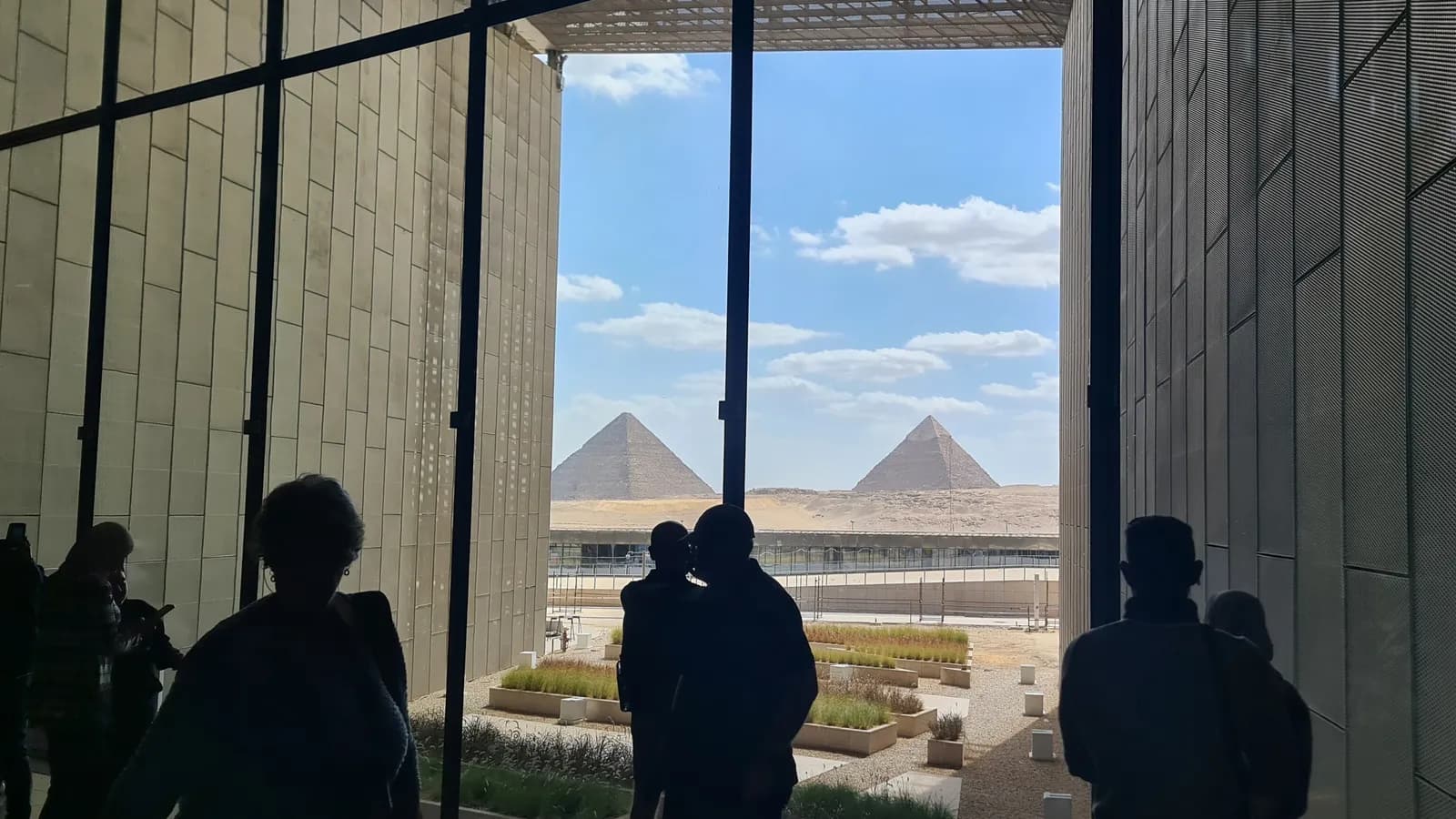
The Great Pyramid of Khufu is the oldest and largest of the three, built around 2500 BC in the 4th Dynasty and still close to 140 metres tall after losing its smooth outer casing. Next to it stands the Pyramid of Khafre, which looks taller because it sits on higher ground and keeps a cap of original casing at its peak, and the smaller Pyramid of Menkaure. The Great Sphinx guards the eastern edge by the Valley Temple, carved from a single ridge of limestone with the face of a pharaoh and the body of a lion.
The site is bigger than photos imply. From the Sphinx entrance to the panorama point out in the desert behind the pyramids is a couple of kilometres, which is why almost every visitor either takes a taxi within the site, the internal shuttle, or a camel or horse. The classic ride is about 30 minutes, looping out to the viewpoint where all three pyramids line up.
Tickets: what each one covers (2026)
Entry is now card-only at the official windows, and the passes stack. Here is what each buys, at 2026 rates:
| Ticket | Foreign adult (approx.) | Notes |
|---|---|---|
| General plateau admission | ~700 EGP | All three pyramids and the Sphinx from outside |
| Inside the Great Pyramid | ~1,000 EGP extra | 300 tickets a day, released 150 at 8am and 150 at 1pm |
| Inside Khafre or Menkaure | ~100 EGP extra | Cheaper, shorter queues, often better value |
| Solar Boat / special enclosures | own fee | Separate ticket |
Students with valid ID pay roughly half on most tickets. The two extras that catch people out are the interiors and the Sphinx enclosure. Going inside a pyramid means climbing a low, steep, airless passage into an empty burial chamber. There is no treasure and no carving, just the raw engineering. The Great Pyramid interior costs the most and its 300 daily tickets sell out first, so buy that one at opening; the Khafre and Menkaure interiors give a very similar experience for a fraction of the price with shorter queues. Skip-the-line and combo tickets that pair the plateau with the Grand Egyptian Museum are increasingly common, and one of the most-booked options in our catalogue is exactly that combination.
Do not stop at Giza: Saqqara, Dahshur and Memphis
The mistake first-timers make is treating Giza as the whole story. The most rewarding pyramid day adds the older sites just to the south, and many tours build the fuller loop:
- Saqqara, about 40 minutes from Giza, holds the Step Pyramid of Djoser, the world's first pyramid and the oldest large stone building on earth. The site is a vast necropolis, the ancient "City of the Dead", with painted tombs and the underground Serapeum.
- Dahshur is where the pyramid was perfected. The Bent Pyramid shows the moment the builders changed the angle mid-construction, and the neighbouring Red Pyramid is the first true smooth-sided pyramid, which you can usually enter with far fewer people than at Giza.
- Memphis, the ancient capital of the Old Kingdom, is now an open-air museum with a giant recumbent statue of Ramses II and the alabaster Sphinx.
Seeing Djoser's step pyramid, Dahshur's true pyramids and Giza's giants in one day tells the whole arc of how pyramids evolved. It is the single best upgrade to a standard Giza visit, and we lay out the full loop in Beyond Giza.
The tours travellers actually book
Most visitors do not arrive independently. The highest-rated option in our catalogue is a private Pyramids and Sphinx tour with a camel ride, from about 2,377 EGP (roughly 49 USD) per person, holding a 4.91 rating across more than 7,000 reviews. A straightforward half-day Giza and Sphinx tour runs from around 2,246 EGP, and a combined Grand Egyptian Museum, Pyramids and Sphinx tour with lunch sits near 4,136 EGP. Private day tours that stack Giza with Saqqara, Dahshur and Memphis, with an Egyptologist, entrance fees and hotel pickup, are widely sold from a few hundred to a few thousand EGP depending on how much they include.
The reason a tour wins here is not the entry ticket, which you could buy yourself. It is the transport between sites spread across 40 kilometres of desert, an Egyptologist who explains what you are seeing, and someone to handle the touts at the gate so your first hour is not a negotiation. Since GEM opened fully in November 2025, the combined museum-and-plateau day has become the default first-timer plan; see the Grand Egyptian Museum guide for how to time the two.
Camels, horses and the touts
A short camel or horse ride to the desert panorama is genuinely worth it for the classic view of all three pyramids in a line. The scams here are predictable, so handle them head-on: agree the total price and the exact route before you get on, confirm whether it is per person or per group, take a photo of the agreed number, and pay only when you are back on your feet. Ignore the "free" hats, headscarves and "you take my photo" moves, which all end in a demand for cash. If you book a tour, the guide usually arranges the ride at a fixed rate, which removes the haggling entirely. The hard sell on the plateau is real but harmless once you expect it. A firm "no, thank you" and steady walking is all it takes.
Best time to go
Arrive at opening, around 8am, for cool air, soft light and thin crowds. Cairo heat from May to September is punishing by midday, and there is almost no shade on the plateau or at Saqqara. Winter, from November to February, is the ideal season, which the best time to visit Egypt guide covers month by month. Late-afternoon light is beautiful for photography but the site closes in the early evening, so it is a tighter window. The nightly Sound and Light show is a separate evening ticket, projecting the pyramids' history onto the monuments themselves; it is touristy but fun, and a good use of an evening you are not touring.
Practical notes
- Wear closed shoes. The plateau and Saqqara are sand, gravel and loose stone.
- Bring water, a hat and sunscreen. Shade is scarce at every site.
- Cards work at official windows, but carry small cash for camels, tips, restrooms and extra tomb tickets.
- Buy the Great Pyramid interior ticket at 8am if you want it; the 300 daily tickets go fast.
- The Sphinx enclosure is entered separately, near the Valley Temple.
- Give three to four hours for Giza alone, or a full day if you add Saqqara, Dahshur and Memphis.
Giza sits at the heart of any Cairo stay and near the top of the best things to do in Egypt. Once you have the plateau and the museum sorted, you can browse Giza and Cairo experiences to book the exact tour, camel ride or combo that fits your day.
Common questions
How much does it cost to visit the Pyramids of Giza in 2026?
General plateau admission is around 700 EGP for a foreign adult (about half that for students). Going inside the Great Pyramid costs roughly 1,000 EGP more; the smaller Khafre and Menkaure interiors are about 100 EGP each. Entry is card-only. Most visitors book a guided tour for the transport and Egyptologist, from around 2,377 EGP with a camel ride.
Can you go inside the Pyramids of Giza?
Yes. A separate, limited ticket lets you climb into the Great Pyramid's burial chamber through a low, steep passage. Only 300 tickets are sold daily, released 150 at 8am and 150 at 1pm, so buy early. The chamber is empty, so the appeal is the engineering. The Khafre and Menkaure interiors give a similar experience for far less money with shorter queues.
How long do you need at the Pyramids?
Plan three to four hours for the plateau and Sphinx at a comfortable pace, or a half day if you also go inside a pyramid. Adding the Grand Egyptian Museum two kilometres away makes it a full day.
What is the best time of day to visit the Pyramids?
Arrive at opening around 8am for cool air, soft light and fewer crowds. Midday heat from May to September is intense with almost no shade. Winter, November to February, is the most comfortable season. The evening Sound and Light show is a separate ticket.
Should I ride a camel at the Pyramids, and how do I avoid the scam?
A short ride to the desert panorama is worth it for the classic three-pyramid view. Agree the total price and route before mounting, confirm per-person versus per-group, photograph the agreed number, and pay only at the end. Ignore 'free' hats and photo offers. Booking a tour usually fixes the ride at a set rate and avoids haggling.
Should I visit Saqqara and Dahshur too?
Yes, if you have a full day. Saqqara holds the Step Pyramid of Djoser, the world's first pyramid, and Dahshur has the Bent Pyramid and the Red Pyramid, the first true smooth-sided pyramid, which you can often enter with far fewer crowds than at Giza. Seeing all three sites tells the whole story of how pyramids evolved, and many tours combine them with Memphis.
How do the Pyramids combine with the Grand Egyptian Museum?
The museum is about 2 kilometres from the plateau and opened fully in November 2025. Most first-timers now do both in one day, with combined skip-the-line tickets and guided tours covering both from about 3,100 to 4,100 EGP. Do the museum in the cooler morning and the plateau later, or the reverse for sunrise light.
Is there a Sound and Light show at the Pyramids?
Yes. A nightly show projects the pyramids' history onto the monuments with narration and lighting; it is a separate evening ticket from daytime admission. It is unashamedly touristy but a pleasant use of an evening you are not otherwise touring.
Book it on This is Egypt
Turn this guide into a trip
Luxor Day Trip from Hurghada Small Group & Tutankhamun Tomb

Tour to Pyramids & The Grand Egyptian Museum

Hot Air Balloon Ride in Luxor Egypt with Transfers Included
Attractions in this guide
Keep reading
Hurghada Diving (2026): Best Sites, Packages & Prices
Diving in Hurghada — the best reefs (Giftun, Careless Reef, Dolphin House) and Abu Nuhas wrecks, Discover Scuba vs PADI courses, season and water temps, and real 2026 prices.
By TiE Editors7 min read
Hurghada Snorkeling Trips (2026): Best Reefs, Prices & How to Choose
Where to snorkel from Hurghada in 2026 — Orange Bay, Giftun, Mahmya, Utopia and Dolphin House — with boat types, marine life, month-by-month sea temperatures, family tips and real prices from 1,000+ bookable trips.
By TiE Editors7 min read
Egypt Tour Prices by Activity (2026): What Each Type Really Costs
What every type of Egypt experience actually costs — from a 1,700 EGP camel ride to a 48,500 EGP Nile cruise — based on 29,710 real bookable tours across seven platforms.
By TiE Editors6 min read